
What We Can See from Europe’s Outdoor Structures Market? Insights and Opportunities
Sheds were originally built because people needed more space, and that is still the main reason people buy them today. People often buy a shed when their garage runs out of space or bikes begin cluttering the hallway. Sheds now come in far more materials and designs than they used to, but their main purpose remains the same: to keep belongings come out in the same condition they went in.
Beyond simply storing belongings, a shed might support gardening projects, shelter bikes, serve as a patio bar, or provide a workspace with tools hanging above a wall-mounted bench. Other outdoor structures, however, are designed around more specific purposes. A pergola turns a patio into a comfortable space the family can use from May through September ,and a carport or garage provides dedicated protection for vehicles. The market has evolved to meet a wider range of outdoor space needs
One thing is driving all of this, everywhere in the world: families are spending more of their home budget on the outside of the house than they used to. Grand View Research expects the European outdoor living structure market to grow about 6% a year and reach USD 1.28 billion by 2033.
TL;DR
Storage remains the foundation of Europe’s outdoor structures market, but it no longer explains the category on its own. Gardening, bicycle storage, home workshops, leisure spaces, pergolas, carports and garages are creating adjacent opportunities. Demand varies substantially by country, reflecting differences in housing, climate, transport habits, garden use and retail channels.
What We Mean by “Outdoor Structures”?
In this article, the term “outdoor structures” refers to freestanding or attached products installed in backyards, patios, gardens, and driveways. Unlike outdoor furniture, which primarily supports seating, and dining, outdoor storage structures create enclosed, sheltered, or purpose-built exterior spaces. Some products, including sheds, workshops, greenhouses, and garages, are enclosed garden buildings. Others, including pergolas and carports, are open or semi-enclosed structures that provide shade, weather protection, or defined outdoor space.
How Many Homes Already Have One?
Most gardens already contain something. Around 62% of homeowners in the United Kingdom and 61% in the Netherlands say they own a shed, a gate, or a garden house. That changes the question a supplier should ask: not how many households will buy their first structure, but what those households replace, and what they add next.
Growth rates tell the same story. The European outdoor shed market was worth about USD 1.66 billion in 2021 and is forecast to reach USD 2.26 billion by 2028, which works out at roughly 4.5% a year. Global shed studies forecast 7.1% to 7.2% over similar periods, so Europe is growing more slowly than the world average: the easy first sales have already happened here, and the remaining growth comes from replacement and from people buying a second structure for a new purpose.
Europe still buys a large share of these products, taking about 28.7% of the global garden buildings market. The contrast with North America is useful, because North America takes about 56% of the global residential outdoor storage market, and that market counts boxes and cabinets alongside sheds. Europeans buy buildings they walk into, and North Americans buy more of the storage products that sit against a wall.
Why European Demand Is Broadening Beyond Basic Storage
Much of Europe lives in dense housing with compact or shared outdoor areas, and 16.9% of people in the EU lived in an overcrowded household in 2024. Tools, garden equipment and seasonal items compete for the same few square metres. A large share of Europeans live in flats rather than houses. Without a private backyard or patio, they are not addressable customers for garden buildings. The households that do buy already have the space. What they want from it has moved well past a box to put things in.
Bins and Bikes Moved to the Front of the House
Separate collection of recyclable and food waste is now standard across Europe, so a household may keep three or more containers outside the front door. People buy an outdoor store to keep the smell down and to hide the bins, and they also want the store itself to look good, because it sits at the front of the house where everyone sees it. Bicycles work the same way, because in countries where people ride every day a family owns several bikes and wants them safe, dry and off the hallway floor.
Growing Food Needs More Than a Storage Box
Home growing is well established in Europe. In the UK, the allotment waiting lists are getting longer. Growers need somewhere to keep compost, trays and hand tools, and a greenhouse gives them a longer season, so this buyer looks at greenhouses and potting sheds rather than a plain storage box.
The Shed Became a Room for Work, Hobbies and Flexible Space
More people now use their sheds as an extra room. The same structure sells as a small workshop, a hobby room, a garden bar or a quiet space away from the house, and that buyer looks at windows, insulation, height and finish rather than capacity alone.
Viechle and Equipment Need Cover, not Storage Only
Carports, garages, moto shelters and lawn equipment covers all answer the same problem, which is protecting something valuable that will not fit or does not belong indoors.
How Demand Differs Across European Markets
Demand for outdoor structures varies considerably across Europe. Market size, housing patterns, product preferences and seasonal buying cycles all differ from one country to another. Germany leads in overall import value, while some smaller markets are growing faster or purchasing products with markedly different price and specification profiles.
Customs data provides the most consistent basis for comparing these differences across European countries under a common product classification. It does, however, have an important limitation: the customs codes for prefabricated buildings do not distinguish garden sheds from site cabins or container offices. Eurostat Comext records CN 940690 as prefabricated buildings made from materials other than wood, while its steel subcategory also includes industrial and construction structures.
The three largest markets accounted for 48% of EU27 imports recorded under this code in 2025, with Germany alone representing 23%.
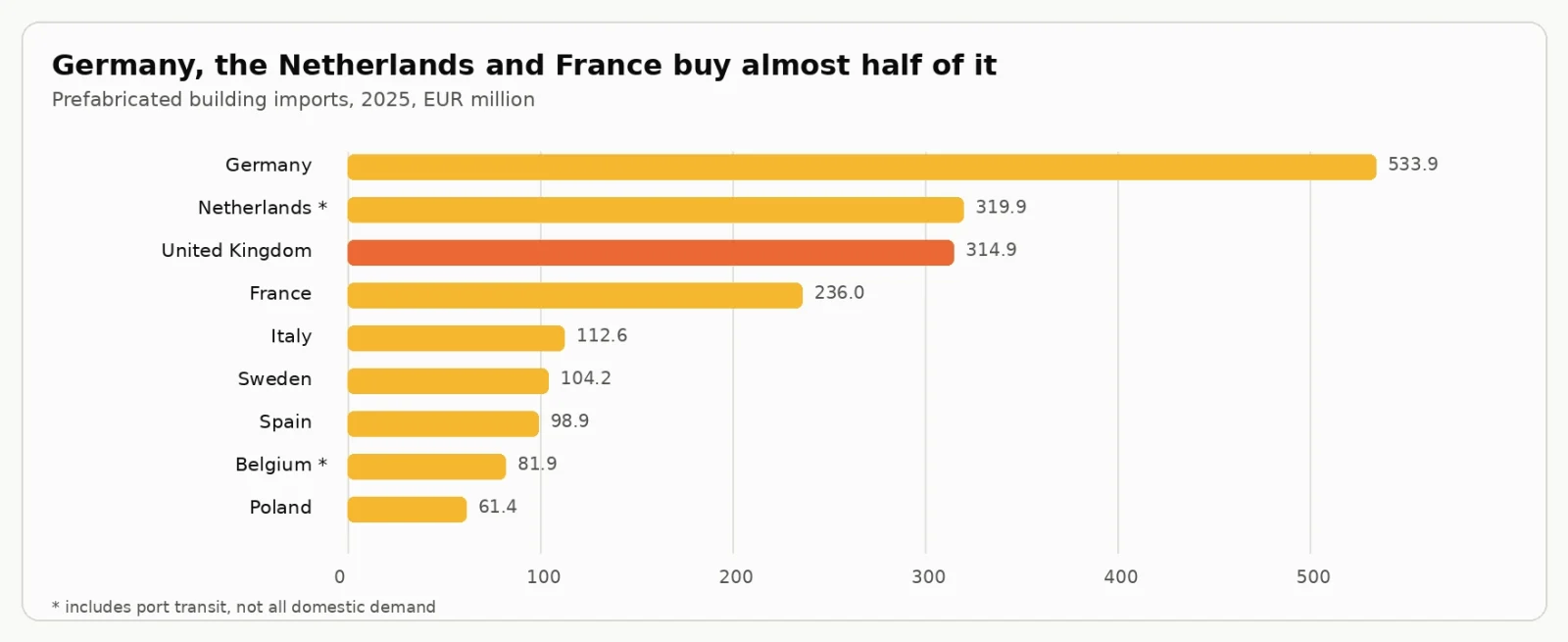
Horizontal bar chart: import value by country, 2025 (€ million).
The Dutch figure should be interpreted with caution. A significant share of goods entering through Rotterdam may subsequently be re-exported to Germany, Belgium, France and other European markets. The €319.9 million total therefore overstates the value ultimately consumed in the Netherlands.
Housing structure may explain part of the cross-country pattern. Countries with a higher share of residents living in houses rather than flats generally have more households with suitable outdoor space for a shed or similar structure.
Germany is an important exception: only 38% of its population lives in a house, yet it remains Europe’s largest importer under this code. Its much larger population helps explain the difference. Poland provides the opposite exception, combining the highest share of residents living in houses in the table with the lowest import value. This underlines that access to a house does not automatically translate into demand for imported outdoor structures.
Import value divided by import weight provides an indicative unit value, which can offer a rough signal of product mix. Finished structures incorporating hardware, glazing and coated components would generally be expected to record a higher value per kilogram than basic steel frames.
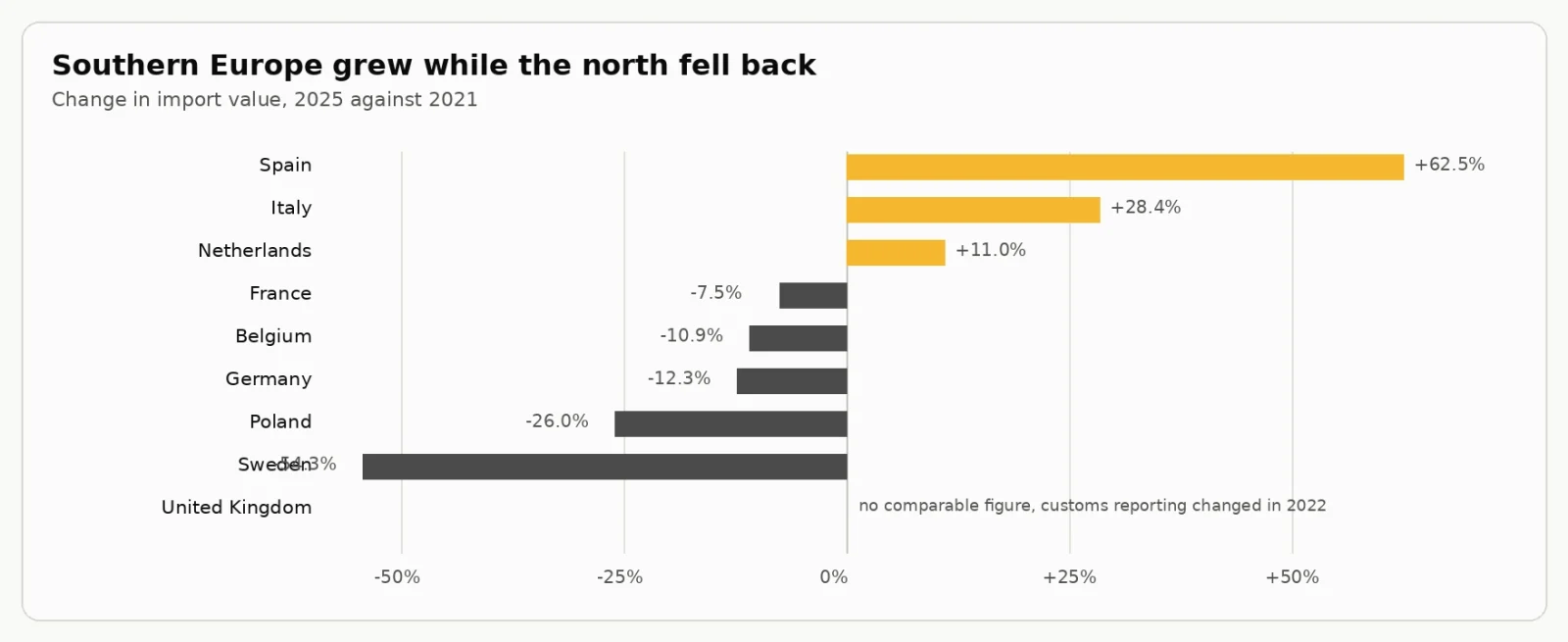
Dot chart: import unit value by country, 2025 (€/kg; EU27 average shown).
Poland recorded an import unit value of €2.00/kg, compared with €5.15/kg in Italy and an EU27 average of €3.45/kg. This is consistent with a heavier, more basic product mix in Poland and a lighter or more highly finished mix in Italy, although the customs data cannot confirm the precise product specifications.
Because the same code also includes site cabins and other non-household structures, unit value is more useful for comparing likely product mix than for estimating expenditure on garden sheds. For suppliers, it can nevertheless provide a useful—though imperfect—indication of markets that may be more specification-led and those that may be more price-sensitive.
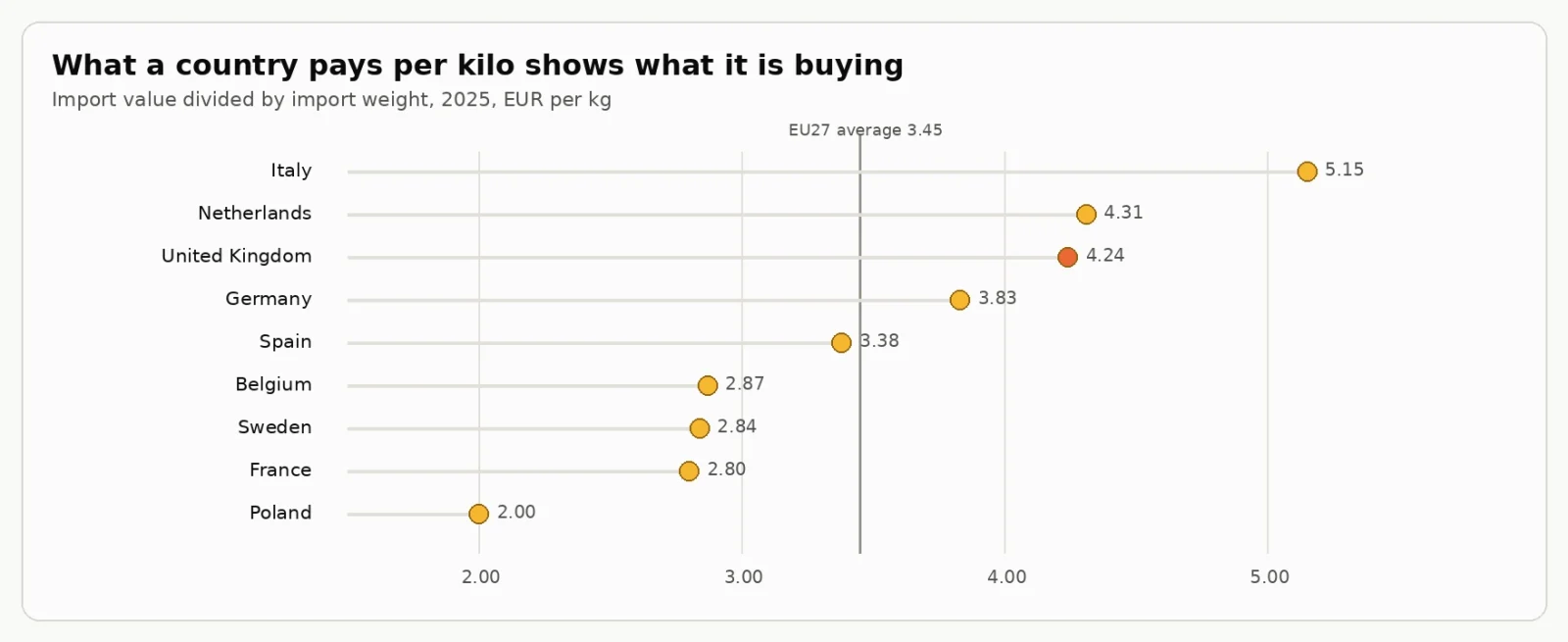
Diverging bar chart: change in import value from 2021 to 2025.
Import value increased by 62% in Spain and 28% in Italy between 2021 and 2025. Outside the nine largest markets, Bulgaria, Romania and Portugal each recorded growth of more than 45%. Over the same period, import value fell by 54% in Sweden, 48% in Denmark and 12% in Germany.
Housing construction and interest-rate conditions may explain part of these movements, because the broad steel-building classification reflects construction activity as well as demand for garden structures. The decline in Sweden therefore does not, by itself, demonstrate that fewer Swedish consumers want a shed. The direction of change is nevertheless informative, highlighting growth opportunities in markets that remain smaller than Germany or France.
Data for the first half of 2026 shows a similar divergence across countries. EU27 imports were down 12% compared with the same period in 2025. Germany declined by 17%, Italy by 21% and Sweden by 28%, while Spain increased by 30%, Finland by 27% and Hungary by 43%. These preliminary six-month figures remain subject to revision and should be treated as directional rather than as a full-year outcome.
Steel greenhouse imports average around 20% above the monthly annual average in March and April and around 20% below it in December. By contrast, imports under the broad steel-building code remain relatively stable throughout the year. Products more directly linked to household purchasing tend to display stronger seasonality, and this difference is useful for production and shipping plans.
Seasonal patterns also vary by country. Sweden’s recorded imports are 64% above its monthly average in April and 57% below it in December. Germany peaks in March, while Italy peaks in June. These figures represent customs clearance dates rather than retail sales. Clearance may precede retail selling by one to two months, suggesting that products intended for the Nordic spring season may need to leave the factory during the previous autumn.
Following Brexit, the UK is no longer covered on the same basis in Eurostat Comext, so comparable analysis requires HMRC data and a matched basket of commodity codes. In 2025, imports under this basket were valued at €314.9 million and weighed 74,300 tonnes, producing an import unit value of €4.24/kg, compared with the EU27 average of €3.45/kg.
Outdoor wooden buildings sit outside this basket and added another €136.6 million at €2.16/kg. The figures point to two distinct product segments in the UK: lower-unit-value wooden buildings and higher-unit-value structures made from steel and other materials.
A conventional long-term growth comparison would be misleading. The UK restored full customs declarations for imports from the EU only in January 2022, meaning that the increase between 2021 and 2022 reflects a reporting change rather than a corresponding increase in demand. Two more reliable comparisons are available. Imports from outside the EU grew at an average annual rate of 10.1% between 2019 and 2025, while total imports under the full basket were broadly flat between 2022 and 2025, declining by 0.5% over the period.
China supplied 19% of the UK basket in 2025, ahead of Italy at 14% and Israel at 13%. Among non-EU imports, for which the reporting break does not apply, China’s share increased from 27% in 2019 to 47% in 2025.
The unit value of imports from China remained between €2.56/kg and €2.90/kg over this period, compared with €8.62/kg for Italy and €6.31/kg for Germany in 2025. The figures suggest that UK buyers source higher-volume, lower-unit-value products from Asia and higher-unit-value products from Europe. These suppliers may therefore be serving different market segments rather than competing directly for identical orders.
One commodity code deserves separate attention because aluminium greenhouses and pergolas fall outside the steel greenhouse code and are classified under “other materials”. In the UK, this was the largest of the four categories in 2025, with an import value of €185.8 million. It was also the only category in which import unit value increased, rising from €3.61/kg in 2021 to €4.75/kg in 2025.
The increase suggests a shift towards higher-value products or higher prices per kilogram, in contrast to the trend observed in the timber and steel categories.
Sources: Eurostat Comext dataset DS-059322, CN 940690, imports from all trading partners; data extracted on 9 September 2026. UK figures are based on HMRC Overseas Trade Statistics for commodity codes 94069031, 94069038 and 94069090 and were converted using Eurostat annual average exchange rates. The complete country-level table is provided in the downloadable appendix.
What the Rules Decide Before the End Buyer Acts
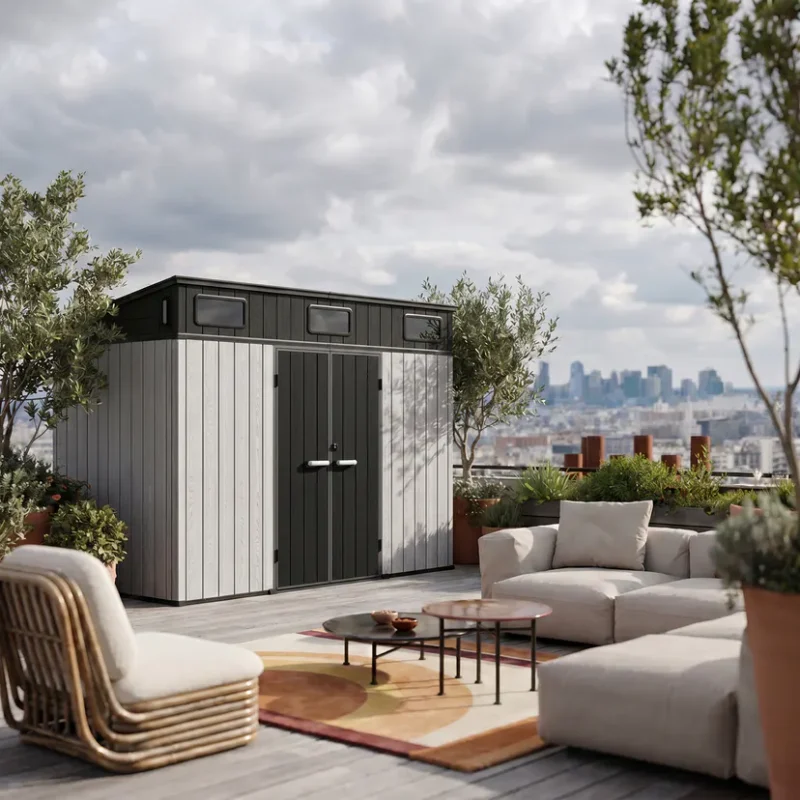
In retailer market, most end customers find out about the rules after they have already chosen a shed, and the size they wanted turns out to need paperwork. Suppliers see the same thing from the other side, as the sizes that sell best in each country tend to be the sizes that stay under the local limit. Approval rules and structural standards are therefore product specifications, not background information.
The Size That Needs No Paperwork Is Different in Every Country
In England, an outbuilding usually falls under permitted development if it is single storey with eaves no higher than 2.5 metres, an overall height of no more than 4 metres for a dual-pitched roof or 3 metres for any other roof, and no more than 2.5 metres anywhere within 2 metres of a boundary. Buildings and extensions together must not cover more than half the land around the original house. A second limit sits behind that one, because building regulations approval is not normally needed below 15 square metres of floor area, and between 15 and 30 square metres a building is still exempt if it stands at least a metre from any boundary or is built substantially of non-combustible materials. That second condition is worth noting for steel and resin structures, because it is one of the few places where the material itself changes the answer.
France sets its thresholds by floor area. A garden building is exempt from any formality up to 5 square metres, needs a déclaration préalable above 5 and up to 20 square metres, and needs a full permis de construire above 20 square metres. The 5 square metre line explains why so many French listings sit just under it.
Germany has no single national answer, because each state writes its own building code. Bavaria treats buildings up to 75 cubic metres of gross volume as permit-free outside the Außenbereich, and allows garages up to 50 square metres on the same basis. North Rhine-Westphalia uses the same 75 cubic metre volume test for buildings without habitable rooms, and exempts covered parking up to 50 square metres with a mean wall height of up to 3 metres. Volume rather than floor area is the German test, so a taller roof eats into the allowance in a way it does not in the UK or France. [Check the current wording of the remaining 14 state codes before publication, and note the date of consultation.]
Snow, Wind and Coating Standards Decide Which Material Wins
Structural loads in Europe are set by the Eurocodes, with snow under EN 1991-1-3 and wind under EN 1991-1-4, and each country publishes its own national annex with the values that apply locally. Snow load is the reason a carport specification that passes in Spain is not the same product in Sweden or Austria. For steel structures, EN ISO 1461 sets coating thickness and test methods for hot dip galvanizing, and EN 1090 governs CE marking for structural steel and aluminium components. Carports and garages carry real structural load, so they sit closer to that compliance boundary than an ordinary storage shed does.
How Outdoor Structures Reach European Buyers
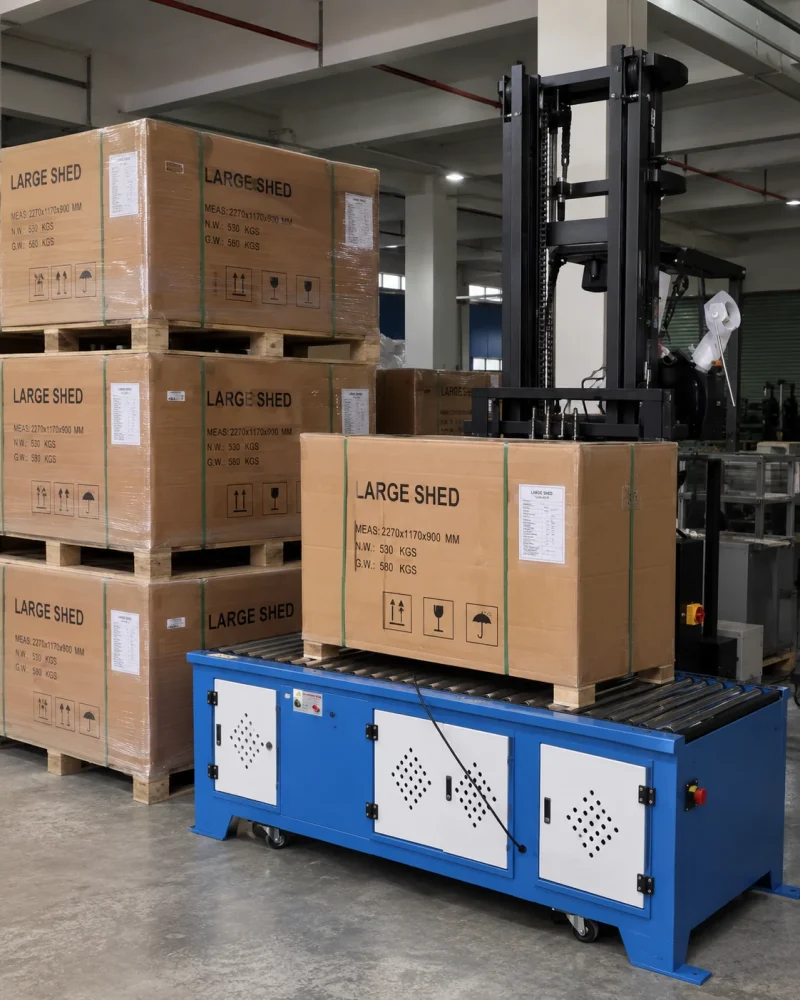
Nobody buys a shed the way they buy a kettle. It is bulky, it is delivered rather than carried home, and it is often bought once every ten or fifteen years. That shapes which channels carry the category and how deep an assortment each one can hold.
Big DIY Chains Still Carry the Volume
The largest home-improvement groups reach most of the buying population directly. Kingfisher reported sales of £12,945 million and 1,691 stores in the year to 31 January 2026, trading as B&Q and Screwfix in the UK and Ireland, Castorama and Brico Dépôt in France, Castorama in Poland and Brico Dépôt in Iberia. HORNBACH reported net sales of €6.4 billion in 2025/26 across 177 locations in nine European countries. A supplier who wins a garden buildings listing at one of these groups reaches several countries under one buying decision, which is why their range requirements set the specification for much of the market.
Garden Centres and Specialists Take the Products That Need Explaining
Greenhouses, prefabricated garages and larger garden rooms are sold more often through garden centres and specialist dealers, because these products involve base preparation, installation and after-sales parts. The conversation before the sale is longer, so the channel that can hold that conversation keeps the higher-priced end of the category.
Online Is Where the Assortment Gets Wide
E-commerce reached 21% of Kingfisher group sales in 2025/26, up from 19%, and its marketplace GMV rose 58% to £518 million, with B&Q’s marketplace alone carrying 3.7 million SKUs and £445 million of GMV. Marketplaces let a retailer list sizes and variants that no store could stock, which is where niche formats such as bin stores, bike sheds and lean-to units usually appear first. ManoMano operates in five countries and is built around DIY and garden specifically. Review counts on these sites are not sales figures and should never be used as a proxy for volume.
Importers and Private-Label Programmes Sit Behind All of It
Much of what appears under a retailer’s own brand is bought by container programme from a manufacturer, with an exclusive configuration, local warehousing, translated instructions and a replacement-parts commitment. This is where a multi-material supplier competes, because a retailer would rather run one programme covering resin, steel and aluminium than three.
Public sources describe the structure of these channels and the products in them well enough to compare assortments. They do not support a calculation of how much volume each channel sells, and this article does not attempt one.
As the European outdoor structures market is relatively mature, new brands and suppliers may find it difficult to compete through standard products alone. A more promising opportunity is to develop customised DIY and private-label ranges around specific customer needs,
Where the Product Opportunities Are Emerging
The gaps in European ranges are not usually in the main shed sizes, which every retailer already carries. They show up in the products bought for one specific job.
Small Yards Need Storage that Lean-to a Wall
Pent-roof and lean-to outdoor buildings, bin stores and bike sheds all solve the same problem, which is finding somewhere to put bulky items in a garden that has no spare corner. These products are judged on how narrow they are, how the doors open in a tight space, whether the lock is any good, and whether the roof clears a fence. They also sit where visitors see them, so the finish matters as much as the capacity.
The Shed Used as a Room Is Judged on Finish, Not Volume
A structure sold as a workshop, hobby room or garden bar competes on windows, headroom, wall fixings and how it looks from the house. A buyer choosing between two units at the same price will take the one that looks like part of the house rather than part of the yard.
Growers Buy Structures, Not Boxes
Greenhouse buyers look at frame material, glazing options, ventilation and how the structure holds up over several seasons. Aluminium dominates here because it does not rust and the profile holds glazing without extra hardware.
Vehicles and Shade Are Two Different Engineering Problems
Carports and garages have to carry snow and wind load, so they are specified like structures. Pergolas are bought for shade and appearance in hot and coastal climates, where aluminium and coating quality decide how the product looks after five summers.
| Application | Relevant products | Primary material | Secondary | Why |
|---|---|---|---|---|
| General storage | Sheds, cabinets, deck boxes | Resin | Galvanized steel | No maintenance, no rust, looks closer to the house |
| Bicycle storage | Pent-roof and lean-to sheds | Galvanized steel | Resin | Security and lock fixing, narrow footprint |
| Bin storage | Enclosed bin stores | Resin | Steel | Easy to clean, holds up to spills and smells |
| Gardening | Greenhouses | Aluminium | Not applicable | Corrosion resistance, profile holds glazing |
| Work and hobby | Mini workshops | Galvanized steel | Resin | Span, load and wall fixing |
| Leisure | Shed bars, hobby structures | Resin | Steel | Appearance is the reason for the purchase |
| Vehicle protection | Carports, garages | Galvanized steel | Aluminium | Structural load and snow requirements |
| Outdoor living | Pergolas | Aluminium | Steel | Durability under UV and coastal conditions |
Outdoor resin cabinet sheds and deck boxes belong to this list as products, but they are not buildings and are not counted in any of the market figures earlier in this article.
What This Means for Retailers and Private-Label Brands
One European Range Will Not Fit Every Country
Housing, climate, approval limits and cycling habits differ enough that a range built for one market arrives in another with the wrong sizes. The practical unit of planning is a country range built on shared tooling, not a single European assortment.
The Range Should Be Organised by Job, Not by Size
Most ranges are still laid out by shed size. Buyers arrive with a job in mind, which is storing bins, storing bikes, potting seedlings, working on a bench or parking a car. A range organised that way answers the search the customer actually types.
Three Materials Do Different Work, So Treat Them as Complements
Resin, galvanized steel and aluminium each win in different applications and climates, as the table above sets out. Sourcing all three from one supplier is what makes a job-based range possible without running three separate programmes.
Buying Has to Be Planned Around a Spring That Arrives Once
This category sells in a short window and the weather moves the number. Kingfisher attributed a 6.5% rise in seasonal like-for-like sales at B&Q to outdoor categories in the first quarter, helped by favourable UK weather, and noted that a poor first half in Poland was partly offset by better weather in the fourth quarter. Customs clearance data shows the same shape earlier in the chain, with Swedish imports 64% above the monthly average in April and 57% below it in December. Goods for a Nordic spring need to leave the factory the previous autumn, so the sell-in decision is made a full season before the customer sees the product.
Packaging and Delivery Are Part of the Product
Flat-pack dimensions decide carrier cost, pallet count and whether a unit can be delivered by a standard home-delivery service. Assembly time and instruction quality decide the review score, and the review score decides the reorder.
How DiBiBi Supports Multi-Category Outdoor Programmes
DiBiBi manufactures on three material platforms, which are resin, galvanized steel and aluminium, so a retailer can build a job-based range across storage, bikes, bins, gardening, leisure and vehicle protection from one supplier.
From raw-material processing to finished outdoor structures, DiBiBi manages its resin, galvanized-steel and aluminium manufacturing processes entirely in-house.
Product development covers structure configurations, internal storage fittings and space-efficient layouts for small backyards. DiBiBi also takes resonpsility for private-label work including packaging, instruction languages and market-specific needs.
What Oppotunites Can We See from the Analyse?
For retailers and private-label suppliers, the practical implication is to evaluate each country through five connected questions: Is the market large or growing? Which household use cases are most relevant? What product specifications are permitted or commercially viable? Which channel can explain, deliver and service the product? Can the supply chain support the required price, timing and packaging format?
The answers point to different opportunity profiles. Large, mature markets may favour scale, replacement demand and private-label programmes. Smaller, fast-growing markets may offer more targeted opportunities in bike storage, bin stores, greenhouses or pergolas. Higher-unit-value markets may support more finished, specification-led products, while lower-unit-value markets may require simpler designs and tighter cost control.
The implication is clear: Europe should not be approached with one uniform range. Storage remains the foundation of the category, but future growth is likely to come from additional use cases such as gardening, cycling and leisure. Resin, galvanized steel and aluminium can serve these needs as complementary platforms, allowing retailers to build country-specific ranges around local demand, regulations, channels and supply-chain conditions.
Methodology and Sources
Market size and growth figures are taken from published market studies, each cited at the point of use with its base year and currency. Figures reported in US dollars have not been converted to euros, and figures from different studies are not added together, because the studies use different product definitions.
Trade figures are drawn from Eurostat Comext for the EU27 and from HMRC Overseas Trade Statistics for the United Kingdom, using the commodity codes below. The two sources use different reporting thresholds and are not combined into a single total.
| Code | Covers | Used for |
|---|---|---|
| 9406 | Prefabricated buildings | Sheds, garden buildings, greenhouses |
| 7308 | Structures and parts of structures, iron or steel | Carports, garages, steel components |
| 7610 | Aluminium structures and parts | Pergolas, greenhouse frames |
| 3925 | Builders’ ware of plastics | Resin sheds and cabinets |
Customs classifications do not isolate every outdoor structure category. Selected prefabricated-building, metal-structure, aluminium-structure and plastics codes are therefore used as directional trade proxies. Import values and weights are not treated as retail sales or unit volumes.
Housing and household statistics come from Eurostat and from national statistical offices. Approval rules are quoted from the responsible authority in each country and were consulted on [date]; local rules change and the current position should be checked with the relevant authority. Structural and coating standards are cited by number. Channel figures come from company annual reports and results statements. Retail assortment observations are based on a dated sample of public product listings and are not a census of the market. [Add sample size, retailers and collection dates before publication.]
View More