
1. Define an Outdoor Structure RFQ That Suppliers Can Quote Equally
An outdoor structure RFQ must make the specification and commercial assumptions comparable. Send the same model, target market, performance questions, and requested documents to every shortlisted supplier. Otherwise, a thinner panel or lighter frame can appear to be a price advantage.
Include external dimensions and usable clearance, roof form, frame and covering materials, coating, anchors, accessories, color, branding, and packaging limits. State trial quantity and annual forecast separately. Identify who supplies the foundation and whether wind or snow claims assume a particular anchoring arrangement. Specify the named delivery place and Incoterms rule, not an abbreviation alone.
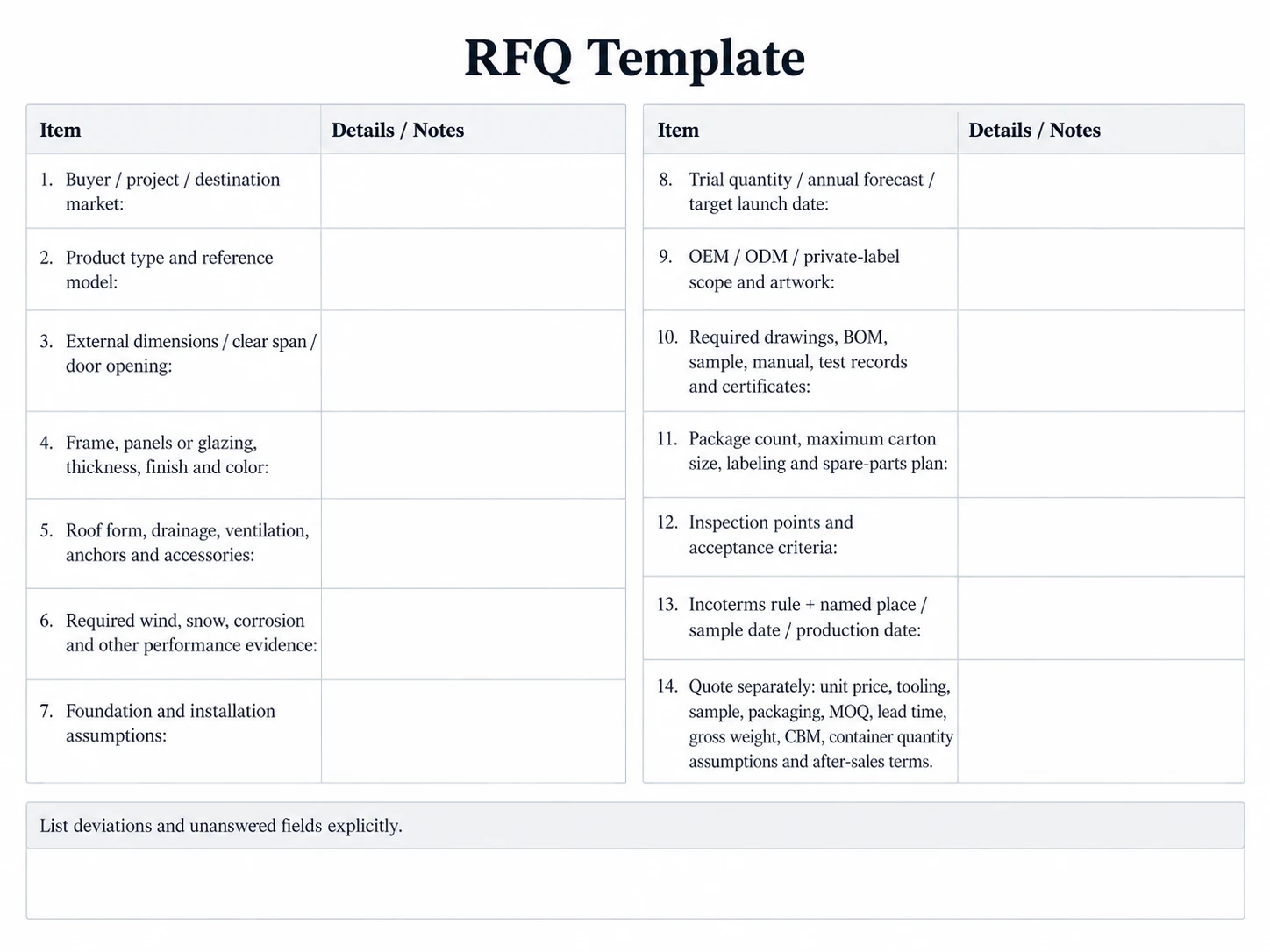
Copy-ready RFQ template
Buyer / project / destination market:
Product type and reference model:
External dimensions / clear span / door opening:
Frame, panels or glazing, thickness, finish and color:
Roof form, drainage, ventilation, anchors and accessories:
Required wind, snow, corrosion and other performance evidence:
Foundation and installation assumptions:
Trial quantity / annual forecast / target launch date:
OEM / ODM / private-label scope and artwork:
Required drawings, BOM, sample, manual, test records and certificates:
Package count, maximum carton size, labeling and spare-parts plan:
Inspection points and acceptance criteria:
Incoterms rule + named place / sample date / production date:
Quote separately: unit price, tooling, sample, packaging, MOQ, lead time,
gross weight, CBM, container quantity assumptions and after-sales terms.
List deviations and unanswered fields explicitly.
Keep deviations visible in your comparison sheet. A supplier that cannot confirm a requirement should mark it as an open item, rather than silently assuming a different specification.
2. Verify Supplier, Manufacturer, Factory, OEM, and ODM Responsibilities
A supplier can be a trading company, a manufacturer, or a group coordinating several plants. A factory is the physical production site; the company issuing the quotation may not own it. OEM and ODM describe commercial arrangements, but neither label establishes which party controls the final design.
Ask who performs extrusion, injection molding, cutting, forming, welding, coating, final packing, and inspection for the specific product. Record the site, subcontractors, owner of tooling and drawings, and who may approve material substitutions. For ODM, document which elements of the existing design can be changed and which require new testing. For OEM, confirm who retains the controlled BOM, CAD files, artwork, and test reports after an order ends.
Decision rule: if the quoting company cannot identify the production site or explain how subcontractors are controlled, pause the shortlist until it supplies a traceable process map.
3. Shortlist Outdoor Structure Suppliers by Product and Market Fit
Screen for the product actually being purchased. Experience with a small resin cabinet does not by itself establish the ability to make a steel-reinforced shed or a wide-span carport. Ask for comparable models, production photos, drawings, recent inspection examples, packaging details, and references that can be checked with consent.
| Screening question | Useful evidence | Weak answer to investigate |
|---|---|---|
| Can the site make this product family? | Relevant process and line records | Only a catalog covering unrelated categories |
| Can engineering control variants? | Drawing revision, approved BOM and change log | Sample differs from the quoted specification |
| Can it serve the destination market? | Model-specific documents and language-ready manuals | An unrelated certificate or logo collage |
| Can it deliver a trial order and replenish? | Line schedule, lead-time basis, spare-parts plan | Capacity stated without a proposed line |
| Can it ship the quoted quantity safely? | Carton schedule and loading evidence | Container quantity without carton dimensions |
Use this screen to reduce the list before requesting samples or paying for a full audit. Record every missing answer so it can be checked later.
4. Check Product-Specific Risks Before Approving the Design
The same sourcing checklist cannot stand in for the same technical checklist across every structure. Ask for measured values and test conditions on the quoted model. Avoid treating the example questions below as universal minimum standards; set acceptance criteria for the destination market and approved configuration.
| Product | Design and material evidence | Sample or installation checks | Logistics and after-sales checks |
|---|---|---|---|
| Resin or metal shed | Panel material and thickness; reinforcement; coating or UV formulation; roof drainage; vent and lock details | Door opening, hinge fit, panel alignment, roof joints and anchor locations | Carton count, fastener labeling, replacement panels and installation manual |
| Garden greenhouse | Frame grade and sections; PC or glass specification; glazing retention; roof form and vents | Door travel, glazing fit, vent operation, frame alignment and foundation interface | Fragile-part protection, replacement glazing and labeled cartons |
| Carport or garage | Clear span, post and beam sections, connection detail, coating, wind/snow design assumptions | Base plate, anchor pattern, roof connection and site clearance | Long-part handling, package length, unloading method and replacement connectors |
| Pergola | Post and roof configuration, drainage route, finish and optional controls | Louver or retractable operation, water path, fasteners and anchors | Component labeling, protected profiles and serviceable moving parts |
For load claims, compare the test or calculation’s model, dimensions, anchoring, foundation, and installation assumptions with the planned sale. If any differs, ask an engineer to explain whether the evidence still applies.
5. Approve a Controlled Sample and Complete Technical Document Set
Approve the physical sample against a revision-controlled drawing and BOM. Record dimensions, material grade, panel or glazing thickness, surface finish, fastener sizes, seals, color, package contents, and any agreed exceptions. Photograph critical joints and label the sample revision so a later production unit can be compared against it.
Do a trial assembly with the intended manual and included hardware. Note missing components, holes that do not align, unclear part labels, damaged packaging, and tasks requiring additional tools or people. Turn each issue into a corrected document, an action owner, and a retest date. Approval of a display sample alone does not establish repeatability.
6. Audit the Factory’s Process, Traceability, and Capacity
Follow the product through incoming materials, fabrication, finishing, assembly, packing, and release. Ask to see the line proposed for your order, the latest inspection forms, an example rejected part and corrective action, and a trace from material lot to finished batch. Check who inspects subcontracted work before it re-enters production.
Factory audit evidence request
- Incoming material identification and a recent inspection record
- Equipment and measurement calibration relevant to critical dimensions
- First-article and in-process checks for the proposed product
- Final assembly and packaging inspection forms
- Nonconformance, rework, and corrective-action records
- Subcontractor list, process owner, and incoming acceptance record
- Production schedule and a plausible peak-season capacity plan
- Carton identification, packing list, and loading inspection record
Classify each document as verified, partly verified, supplier claim only, or missing. A record from an unrelated product line is not evidence for your model. Escalate missing critical controls before placing a trial order; request a dated corrective action for a minor gap.
7. Match Tests, Certification, and Local Requirements to the Model
First determine what rules apply in the destination market and who is responsible as manufacturer, importer, or brand owner. Then match each document to its issuing body, product model, configuration, test conditions, validity, and scope. Ask for wind and snow documentation together with anchor, connection, and foundation assumptions where relevant. For motorized products, review the applicable electrical and safety documentation as well.
Do not assume every garden structure needs a CE mark, or that a CE logo proves compliance. A CE mark is applied only when relevant EU legislation provides for it. Confirm the applicable framework for the exact product and market before asking for a particular mark.
Decision rule: do not approve a claim such as “tested for 100 km/h wind” unless the test configuration, anchoring and acceptance criteria are available and comparable to the quoted model. Use product-specific evidence, not a certificate from a different model or material.
8. Compare Quotations by Landed Cost and Delivery Risk
Normalize the price against the same approved configuration and shipment assumptions. Use the ICC’s Incoterms rules guidance to specify the rule and named place, then ask who pays for export handling, main carriage, import clearance, and destination delivery under the agreed arrangement. Verify the landed-cost calculation with a freight provider and destination-specific duty data.
| Cost or risk | What to request from every supplier |
|---|---|
| Product and development | Unit price, tooling ownership, sample charges, MOQ, price breaks |
| Production | Sample lead time, production lead time, capacity assumption |
| Packaging | Carton count, dimensions, gross weight, protection method |
| Shipping | Total CBM, container type, loading pattern and actual loading evidence |
| Post-delivery | Warranty scope, claim handling, spare-parts price and dispatch time |
Calculate an indicative landed unit cost from product, packaging, allocated tooling, freight, duties and inland handling for the same order quantity. Compare the quoted container capacity with the carton schedule and weight distribution. A supplier’s theoretical maximum is not the approved loading plan. Plan a link to the Outdoor Structure Container Loading Guide once its final address is live.
Release Orders Through Four Quality Gates
Move from proposal to repeat orders using named approval owners and retained evidence. The four gates are a project workflow, not a claim that any certification scheme requires this exact sequence.
| Gate | Evidence required to pass | If the gate fails |
|---|---|---|
| Design | Approved drawing, BOM, materials, load assumptions and package limits | Revise the design and re-quote deviations |
| Sample | Measured sample, assembly check, corrections and approved photos | Correct and re-evaluate the sample |
| Trial order | First-article, production inspections, packaging and loading records | Contain affected units and document corrective action |
| Mass production | Stable inspection plan, change control, lot traceability and release criteria | Suspend release until the change is approved |
Never let a verbal change to hardware, coating, carton layout, or subcontractor pass directly into production. Record the revised drawing or BOM, its impact on tests and packaging, and who authorized it.
Put Change Control, Warranty, and Claims into the Agreement
The purchase agreement should refer to the approved specification and revision, inspection rights, packaging standard, delivery terms, required documents, and acceptance criteria. Define the warranty start point, exclusions, response times, spare-parts process, and what evidence is needed for a claim. Distinguish a design defect from transit damage and missing parts so responsibility can be investigated rather than assumed.
Set written notification and approval requirements for changes that affect performance, installation, compliance, or shipment. Specify what happens to stock already produced under the old revision and how replacement parts remain compatible. Legal terms should be reviewed for the parties and market involved.
Score Outdoor Structure Suppliers on a 100-Point Basis
Use the scorecard after critical safety and compliance issues are resolved. Score each category from 0 to 5, then calculate weighted points = score ÷ 5 × category weight. For example, 4 out of 5 in a 20-point category earns 16 points. The category weights total 100, so the maximum total is 100.
| Category | Weight | Score (0–5) | Weighted points | Evidence / open issue |
|---|---|---|---|---|
| Product and engineering fit | 20 | |||
| Quality system and traceability | 20 | |||
| Export packaging and logistics | 15 | |||
| Capacity and lead-time control | 15 | |||
| Compliance and technical evidence | 15 | |||
| Landed cost and commercial terms | 10 | |||
| After-sales and spare parts | 5 | |||
| Total | 100 | — |
Give 5 for current, model-specific evidence checked against the requirement; 3 for partial verification; 1 for an unsupported claim; and 0 for missing or contradictory evidence. Use 2 and 4 when the evidence falls between these anchors, and explain the choice. Set the minimum acceptable total before evaluating the quotations, but treat a missing legally required document, unexplained material substitution, hidden critical subcontracting, or refusal of agreed inspection as a separate hold. A high average score cannot cancel a critical failure.
How DBB Can Support a Buyer from RFQ to Repeat Order
DBB can coordinate a buyer’s product requirements, sample review, quality checks, packaging planning, and shipment preparation across the sourcing process. Start by sending the target market, product type, required size, trial quantity, and available specification. Ask DBB to identify which drawings, product specifications, installation materials, relevant test records, packaging details, and spare-parts information are available for the specific model being discussed.
Send DBB your project RFQ to request a model-specific document and packaging review. Request a quote today!
Outdoor Structure Sourcing FAQ
What belongs in an outdoor structure RFQ?
Include product configuration, dimensions, materials, target market, trial and annual quantities, required performance evidence, package limits, inspection criteria, spare parts, and the named delivery place. Require suppliers to list deviations.
How can an importer verify a supplier’s factory?
Confirm the production site and subcontractors, then review product-specific process records, a controlled sample, inspection results, lot traceability, capacity evidence, and packing records.
What is the difference between OEM and ODM sourcing?
OEM generally follows the buyer’s branding or specification; ODM generally adapts a supplier’s existing design. Define ownership of drawings, tooling, BOM, test reports, and future revisions in the contract.
Can the lowest quotation still have the best landed cost?
Yes, but compare the same configuration and include packaging, allocated tooling, verified shipping assumptions, duties, inland handling, warranty support, and damage risk before deciding.
When should a supplier be put on hold?
Pause approval if critical model-specific evidence is missing, sample defects are unresolved, substitutions are unexplained, subcontracting is hidden, or the agreed inspection process is refused.