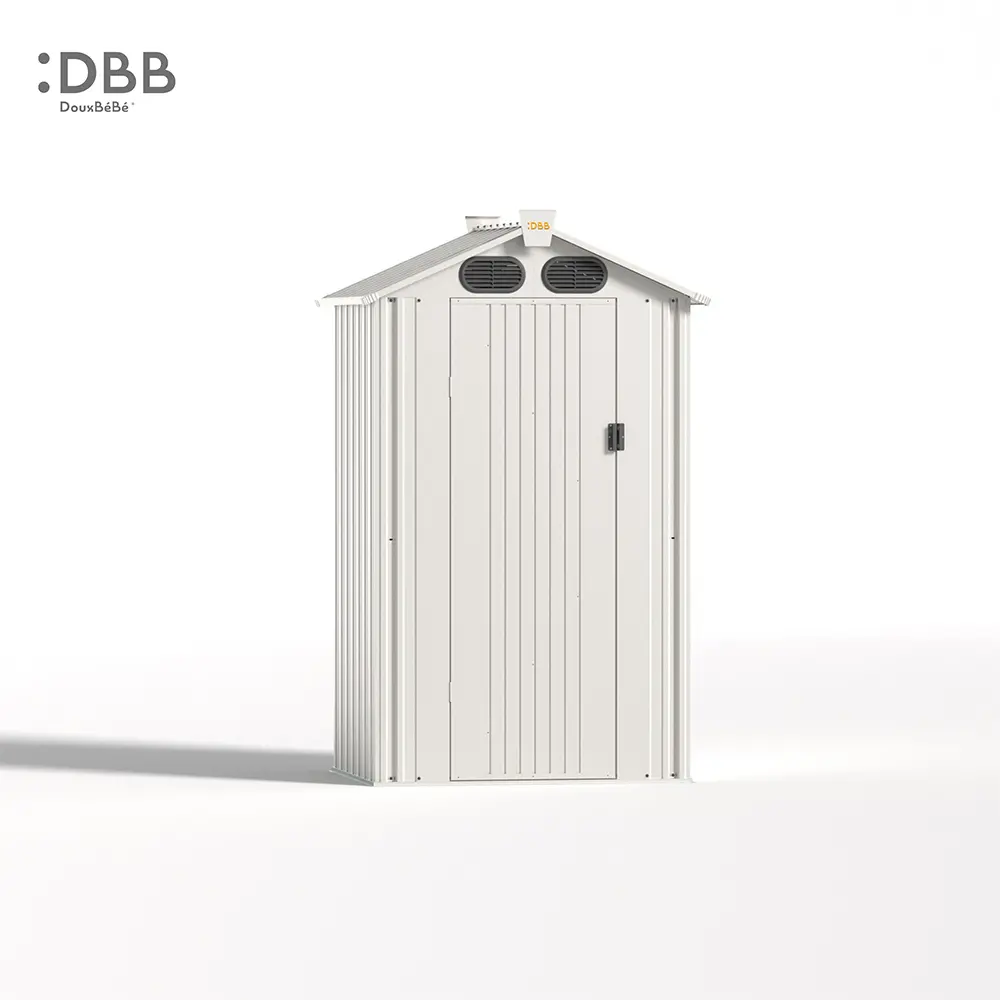
Aluminum vs. steel outdoor structures is a common material-selection question for engineers, contractors, and procurement teams. From pergolas, canopies, and walkway covers to equipment frames, shelters, and support structures, both metals can deliver reliable outdoor performance. However, they differ significantly in weight, stiffness, corrosion behavior, finishing options, maintenance requirements, and total project cost.
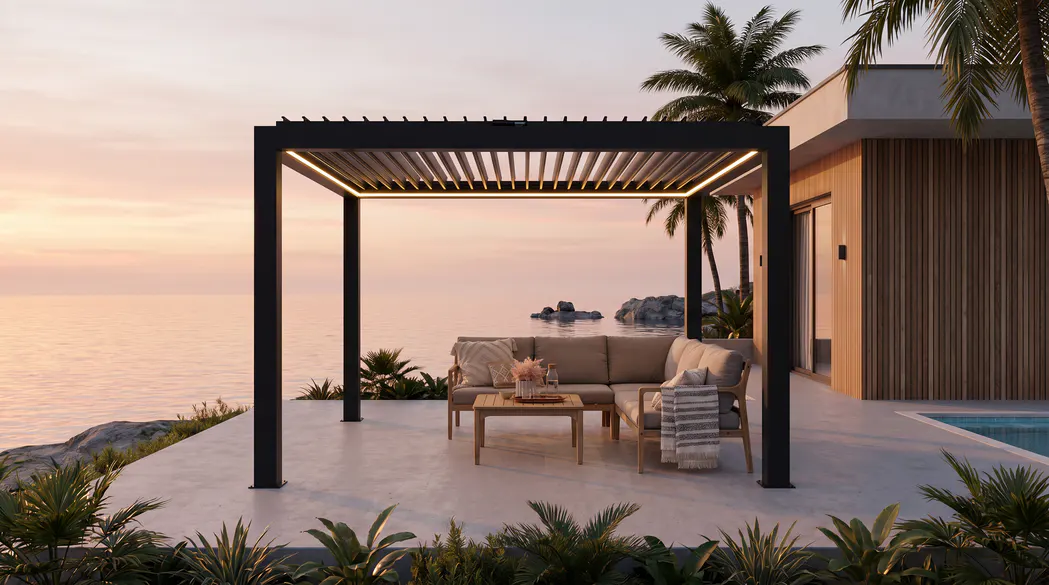
The right choice is rarely determined by material price alone. A lightweight aluminum assembly may reduce transport and installation costs, while a galvanized steel frame may offer greater stiffness and economical load-bearing capacity. Exposure conditions, design life, fabrication methods, and coating quality can change the final decision.
This guide compares both materials from an engineering and purchasing perspective and explains how to specify an outdoor metal structure that performs as expected.
In salt-air locations, the material choice should be checked against coastal installation requirements before the finish is specified.
Aluminum vs. Steel: Quick Comparison
| Selection factor | Aluminum structures | Carbon steel structures |
|---|---|---|
| Typical density | Approximately 2,700 kg/m³ | Approximately 7,850 kg/m³ |
| Weight at equal volume | Roughly one-third of steel | About 2.9 times aluminum |
| Elastic modulus | Approximately 69–70 GPa | Approximately 200–210 GPa |
| Structural behavior | Lightweight; larger sections may be needed for stiffness | High stiffness; efficient for many heavy-load frames |
| Corrosion behavior | Forms a protective oxide film, but can pit or suffer galvanic corrosion | Rusts when unprotected; benefits from galvanizing or suitable coating systems |
| Common finishes | Anodizing, powder coating, liquid painting | Hot-dip galvanizing, powder coating, protective paint systems |
| Routine maintenance | Often low with suitable alloy and finish | Depends strongly on coating system and exposure |
| Initial material cost | Often higher per kilogram | Often lower per kilogram |
| Best-fit applications | Modular canopies, architectural frames, movable or lightweight assemblies | Large spans, high-load supports, industrial frames, impact-prone structures |
Values are representative, not guaranteed design properties. Compare specific alloys, grades, tempers, section geometries, and applicable design codes before specifying a product.
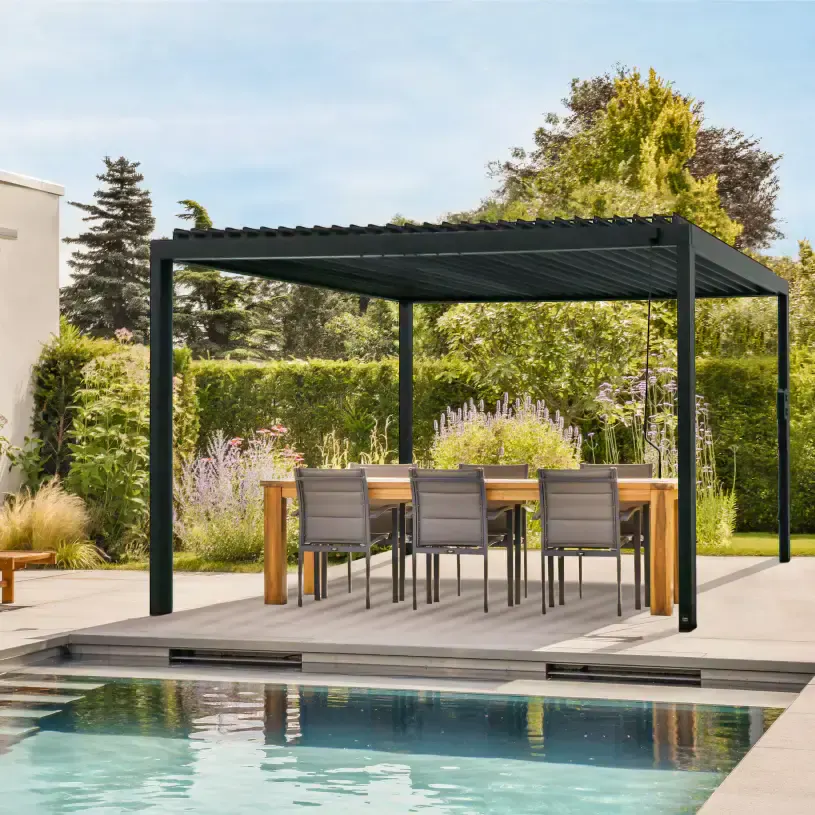
1. Weight: Why Aluminum Simplifies Handling and Installation
Weight is one of aluminum’s clearest advantages. Its density is approximately 2.7 g/cm³, compared with about 7.85 g/cm³ for carbon steel. A component with the same external dimensions and solid volume can therefore weigh approximately 66% less if manufactured from aluminum.
For outdoor structures, lower dead load can create benefits throughout a project:
- Transportation: More components may fit within vehicle weight limits, depending on packaging and dimensions.
- Installation: Smaller assemblies may be easier to position, reducing lifting requirements and installation labor.
- Supporting structures: Lower dead loads may help when attaching canopies or platforms to existing buildings.
- Modularity: Lightweight sections are practical for prefabricated and relocatable products.
Consider a roof-mounted shade structure. An aluminum frame may place less permanent load on the supporting roof than a geometrically equivalent steel frame. However, equivalent geometry does not mean equivalent performance: aluminum members may require thicker walls or deeper profiles to satisfy deflection and stability criteria.
Engineering takeaway: Compare the weight of fully engineered systems, including brackets, anchors, connections, and surface finishes—not simply the density of two metal samples.
2. Strength and Stiffness: Which Material Handles Loads Better?
Strength and stiffness are different properties. Strength concerns resistance to yielding or failure; stiffness describes how much a member deforms under load. Both matter in outdoor structures exposed to wind, snow, vibration, or equipment loads.
Common structural steels can provide high yield strength and excellent stiffness. Steel’s elastic modulus is approximately three times that of aluminum, so similarly shaped steel members generally deflect less under the same loading conditions.
Aluminum can also deliver substantial strength, particularly in appropriately selected heat-treated alloys. For example, 6061-T6 and 6063-T6 are used in fabricated or extruded products, although their properties and availability differ. Welding may reduce strength in the heat-affected zones of certain heat-treated aluminum alloys; these reduced properties must be addressed in design.
Steel commonly suits heavy industrial supports, highly loaded columns, and longer-span frames where serviceability governs. Aluminum is often attractive where weight savings, extrusion flexibility, and installation speed are priorities.
For either material, an engineer should check:
- Wind uplift, lateral forces, and local design wind conditions.
- Snow, rainwater ponding, and applicable live loads.
- Member deflection, buckling, and connection capacity.
- Thermal movement and fatigue where relevant.
- Foundation, anchorage, and overall structural stability.
Key point: There is no universally stronger material without naming the alloy or grade, cross-section, loading condition, and failure criterion. Ask suppliers for calculations based on the actual proposed frame.
3. Corrosion Resistance in Outdoor Environments
Corrosion protection is essential for projects that must withstand years of rain, humidity, UV exposure, pollution, or salt-laden air.
Aluminum: Natural Passivation, with Important Limits
Aluminum develops a thin oxide layer that helps protect the underlying metal in many atmospheric environments. Unlike ordinary carbon steel, aluminum does not form the same flaky red rust. This makes it attractive for architectural canopies, pergolas, screening systems, and exterior frames.
Yet aluminum is not corrosion-proof. Chloride-rich environments can cause pitting or crevice corrosion, and contact with dissimilar metals can produce galvanic corrosion when an electrolyte is present. Poor drainage, trapped salt deposits, and unsuitable fasteners can shorten service life.
Protection starts with choosing an appropriate alloy, avoiding water traps, isolating dissimilar metals where needed, and specifying suitable surface treatment.
Steel: Effective Protection Through Coating Design
Unprotected carbon steel is susceptible to atmospheric rust. For outdoor applications, hot-dip galvanizing is widely used because zinc provides both a physical barrier and sacrificial protection. Protective paint systems and duplex systems—galvanizing plus a compatible coating—offer additional options for durability and appearance.
The coating system should match the project’s corrosivity category, service-life expectations, access for maintenance, and fabrication details. Welds, cut edges, bolt holes, crevices, and coating damage deserve particular attention.
Procurement takeaway: Request a documented corrosion-protection specification. “Outdoor grade” or “rust-resistant” is not a sufficiently precise coating requirement.
4. Surface Finishing: Anodizing, Powder Coating, and Galvanizing
Finishing affects not only appearance but also corrosion resistance, color retention, and maintenance budgets.
Aluminum Anodizing
Anodizing electrochemically thickens aluminum’s oxide layer. It produces an integrated surface finish that cannot peel like a conventional organic paint film. Architectural anodizing is suitable for exposed profiles when the coating class, thickness, color, and sealing quality are specified appropriately.
Anodized finishes are especially useful for clean metallic appearances, although color matching can vary with alloy, profile condition, and processing batch.
Aluminum Powder Coating
Powder coating offers a broad choice of colors and surface textures. With effective pretreatment and a suitable exterior-grade powder formulation, it can provide attractive weather resistance. Performance depends on cleaning, pretreatment, film thickness, curing, and the powder chemistry selected for the environment.
Powder coating is common for visible outdoor components such as pergolas, privacy screens, and architectural support frames.
Steel Hot-Dip Galvanizing
In hot-dip galvanizing, fabricated steel is immersed in molten zinc to form a protective coating. For many exposed steel structures, this is a practical baseline treatment. Design teams must consider drainage and venting holes, component dimensions, distortion risk, and post-galvanizing assembly requirements.
Steel Paint and Duplex Systems
Blasted and properly prepared steel can be protected with a specified primer, intermediate coat, and topcoat. Combining a galvanized layer with a compatible paint or powder-coating system can also improve durability and provide a controlled architectural appearance.
| Finish | Typical substrate | Main advantage | Key specification concern |
|---|---|---|---|
| Architectural anodizing | Aluminum | Durable metallic appearance | Class, thickness, sealing, color consistency |
| Exterior powder coating | Aluminum or suitably prepared steel | Wide color and texture selection | Pretreatment, powder grade, cure, adhesion |
| Hot-dip galvanizing | Carbon steel | Zinc-based corrosion protection | Coating standard, venting, drainage, repairs |
| Engineered protective paint system | Steel | Flexible corrosion and appearance options | Surface preparation, layer build, inspection |
| Duplex coating | Galvanized steel | Combined zinc and barrier protection | Coating compatibility and preparation |
A reliable supplier should be able to identify the finishing process, applicable standard, inspection method, and repair procedure—not merely provide a color swatch.
5. Maintenance and Long-Term Durability
For facility owners, the most expensive structure may be the one that requires frequent shutdowns, repainting, or difficult access work.
Properly designed aluminum frames may need relatively little routine attention beyond periodic cleaning and inspection. Check joints, fasteners, drainage paths, scratches, and deposits, particularly in coastal or polluted environments. Even premium coatings benefit from cleaning according to the finish manufacturer’s guidance.
Steel maintenance varies considerably. An appropriately galvanized structure may provide long service with limited intervention in many environments. Painted steel may require localized repairs or eventual recoating, depending on coating condition and exposure. High-performance systems can extend intervals between major maintenance activities.
An effective maintenance plan should include visual inspections, removal of debris and salt deposits, tightening or replacement of components when required, and prompt repair of damaged protective coatings.
Neither material has a universal maintenance-free lifespan. Project-specific exposure, detailing, coating quality, and inspection access determine outcomes.
6. Cost Comparison: Purchase Price vs. Lifecycle Value
Steel commonly has a lower raw-material price per kilogram than aluminum, but price per kilogram is not the same as installed cost per structure. Aluminum’s lower density can reduce handling and lifting costs; customized extrusions may also consolidate multiple parts. Conversely, steel’s stiffness may allow economical smaller sections in demanding load-bearing designs.
A realistic budget should consider six cost categories:
- Material and section costs: Grades, shapes, wall thicknesses, and purchase quantities.
- Fabrication: Cutting, welding, machining, drilling, tolerances, and assembly.
- Surface treatment: Galvanizing, anodizing, powder coating, or multi-coat painting.
- Logistics: Packaging, shipping weight, oversized loads, and damage prevention.
- Installation: Lifting equipment, crew time, anchors, and site access.
- Ownership: Cleaning, inspection, coating repair, component replacement, and disposal.
A useful comparison is total cost of ownership (TCO):
TCO = Initial material + Fabrication + Finishing + Transport + Installation + Scheduled maintenance + Expected repair/replacement costs
For long-life capital projects, discount future expenses to a common present-value basis rather than adding costs incurred in different years without adjustment.
A buyer evaluating two canopy systems should therefore request installed prices, engineering documentation, coating specifications, warranties, and maintenance guidance. The lowest quotation may not represent the lowest cost over 20 or 30 years.
7. Fabrication, Customization, and Assembly
Aluminum is particularly well suited to extrusion, enabling manufacturers to create profiles with integrated grooves, concealed fastening channels, drainage features, and decorative geometry. These design possibilities can simplify modular construction and improve product appearance.
Steel offers extensive fabrication flexibility through plate cutting, rolling, welding, bolting, and readily available structural sections. It is especially practical for large welded assemblies and customized supports requiring robust connections.
Both materials demand careful fabrication controls. Aluminum welding requires suitable procedures and allowances for heat-affected-zone properties. Steel fabrication must account for weld quality, dimensional tolerances, corrosion protection around joints, and finish compatibility.
For repeat orders, ask whether the supplier can support profile/tooling development, CNC machining, factory trial assembly, consistent color batches, serialized components, and inspection records. These capabilities can have as much impact on project execution as the metal itself.
8. Which Material Is Better for Different Outdoor Structures?
Pergolas, Sunshades, and Architectural Canopies
Aluminum is often preferred when low weight, clean lines, color flexibility, and modular installation are important. Steel becomes attractive for more demanding spans, high loads, or distinctive slender structural designs, subject to proper engineering.
Industrial Shelters and Equipment Supports
Galvanized or appropriately coated steel is often a strong candidate for heavy equipment loads, impact exposure, and robust industrial framing. Aluminum may be appropriate for removable shelters, service platforms, and weight-sensitive installations.
Coastal Outdoor Structures
Either material can work, but neither should be chosen solely by the label “corrosion-resistant.” Specify alloy or steel grade, chloride exposure, coating system, isolation of dissimilar metals, drainage, and maintenance access. High-salinity exposure deserves more rigorous review.
Modular and Relocatable Structures
Aluminum frequently offers advantages for transportable displays, lightweight shelters, and prefabricated assemblies. Steel remains viable where repeated impact, connection demands, or load capacity favor its mechanical characteristics.
9. Procurement Checklist: What to Ask a Metal Structure Supplier
Before issuing a purchase order, send potential manufacturers a consistent technical brief. At minimum, request:
- Material identification: Aluminum alloy and temper, or steel grade, with traceable certificates where required.
- Structural documentation: Design loads, applicable code, calculations, drawings, and anchor requirements.
- Corrosion strategy: Intended exposure conditions, coating process, standard, and specified thickness or performance class.
- Manufacturing controls: Weld procedures where relevant, tolerances, inspection points, and trial assembly requirements.
- Surface quality: Color references, finish samples, acceptance criteria, and repair instructions.
- Commercial scope: Tooling, packaging, freight assumptions, lead time, spare parts, and warranty exclusions.
Ask suppliers to quote the same design requirements, not simply the same overall dimensions. Otherwise, proposals may differ in structural adequacy, coating durability, and included accessories, making price comparisons misleading.
For international orders, clarify who is responsible for engineering approval, local code compliance, third-party inspection, and the final installation method.
10. Frequently Asked Questions
Is aluminum better than steel for outdoor use?
Not universally. Aluminum is attractive for lightweight, corrosion-conscious architectural systems, while suitably protected steel often provides economical stiffness and load capacity. The better option depends on structural demands, exposure, appearance, and budget.
Does aluminum rust outdoors?
Aluminum does not develop the typical red iron rust associated with carbon steel. However, it can still corrode, especially through pitting, crevice corrosion, or galvanic interaction under unfavorable conditions.
Is galvanized steel suitable for outdoor structures?
Yes. Properly specified hot-dip galvanizing is a widely used corrosion-protection method for exposed steel. Durability depends on the environment, coating thickness, detailing, and maintenance conditions.
Which is cheaper: an aluminum or steel outdoor frame?
Steel often costs less as raw material per kilogram, but the total installed cost depends on section design, fabrication, finishing, shipping, and installation. Compare engineered project quotations and lifecycle expenses.
Which material requires less maintenance?
Aluminum with an appropriate exterior finish often has relatively low maintenance requirements. Properly galvanized steel can also perform for long periods with limited intervention. In both cases, inspection and cleaning remain important.
Conclusion: Match the Metal to the Project
Choosing between aluminum and steel outdoor structures requires more than a quick strength or price comparison. Aluminum stands out for low weight, extruded-profile flexibility, and natural resistance to many atmospheric conditions. Steel stands out for stiffness, high-load applications, established fabrication methods, and potentially economical structural performance when protected correctly.
For engineers, the priority is a code-compliant design with verified loads, connections, and durability. For procurement professionals, the priority is a complete, comparable specification that captures installed cost and long-term maintenance, not just raw-material pricing.
Planning a custom outdoor metal structure? Share your drawings, project location and exposure conditions, target service life, preferred finish, and estimated order quantity with a qualified fabricator. Request an aluminum and steel option engineered to the same requirements so you can make a defensible technical and commercial decision.
Technical References
- ASM International, Aluminum and Aluminum Alloys (hosted by NIST): https://materialsdata.nist.gov/bitstream/handle/11115/173/Aluminum%20and%20Aluminum%20Alloys%20Davis.pdf
- Aluminum Anodizers Council, Aluminum Surface Anodic Finish: https://members.anodizing.org/page/aluminum-anodic-finish
- Aluminum Extruders Council, Anodizing: https://aec.org/anodizing
- SteelConstruction.info, Hot-dip Galvanising and Other Metallic Coatings for Steel: https://steelconstruction.info/topics/corrosion-protection/metallic-coatings
- American Galvanizers Association, Long Lasting Corrosion Protection: https://galvanizeit.org/hot-dip-galvanized-steel-for-power-infrastructure/hdg-performance-benefits/corrosion-protection
- Council for Aluminium in Building, Finishing: https://c-a-b.org.uk/finishing-2/
Technical note: Material properties and coating recommendations are general guidance. Final structural and corrosion specifications must be verified for the applicable standards, environmental conditions, and product geometry.