Choosing a reliable aluminum pergola manufacturer in China is one of the most important decisions for importers, distributors, contractors, and outdoor living brands. The right manufacturing partner can deliver durable products, competitive pricing, dependable lead times, and the flexibility to support your business as it grows. The wrong supplier may create costly problems, including inconsistent quality, shipping delays, installation difficulties, and warranty disputes.
China has an extensive aluminum fabrication and outdoor structure manufacturing industry. However, not every supplier offers the same engineering expertise, production capacity, or quality control. A professional-looking website or an attractive quotation is not enough to establish reliability.
This guide explains how to evaluate Chinese aluminum pergola factories, compare technical specifications, verify certifications, assess customization options, and reduce risks before placing a wholesale or OEM order.
1. Identify Your Pergola Requirements Before Contacting Suppliers
Start by defining what you actually need. A clear purchasing brief makes supplier quotations easier to compare and reduces the risk of misunderstandings.
Common product categories include:
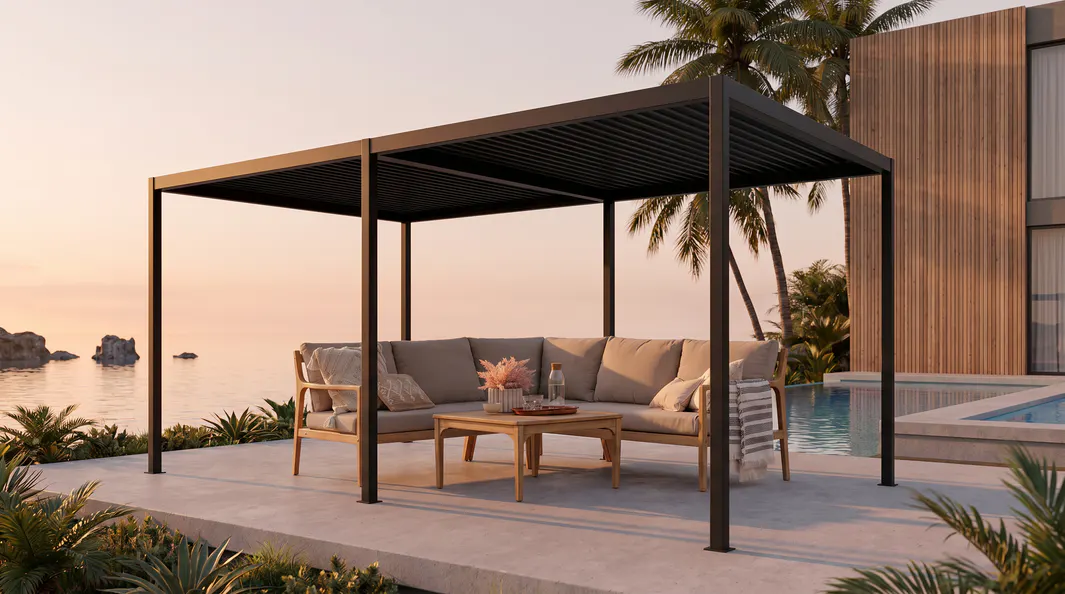
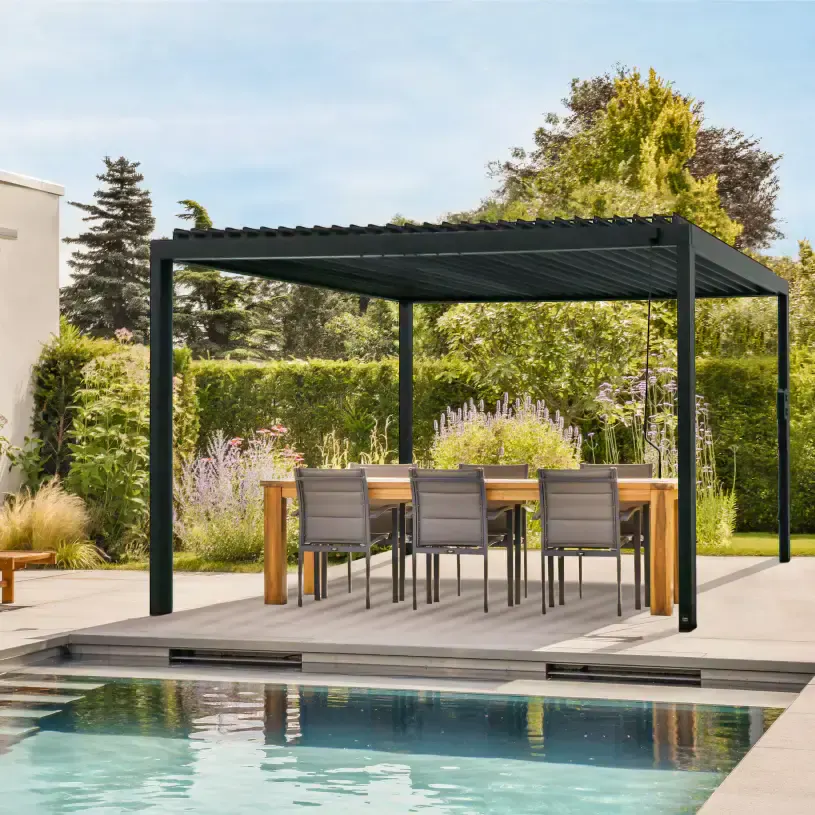
- Manual louvered pergolas: Adjustable roof louvers operated by a hand crank or similar mechanism.
- Motorized aluminum pergolas: Electrically operated louvers, often with optional remote controls, sensors, or lighting.
- Fixed-roof pergolas: Structures with non-adjustable roofing for shade or weather protection.
- Retractable-roof pergolas: Systems with movable fabric or panel roofs, subject to different technical requirements.
- Commercial pergolas: Customized systems for restaurants, hotels, resorts, and hospitality projects.
Determine your preferred dimensions, roof mechanism, frame color, accessories, packaging method, target market, and estimated annual order volume. Also specify whether you need freestanding or wall-mounted structures.
A manufacturer that specializes in residential pergola kits may not be suitable for large commercial installations requiring project-specific engineering. Match the factory’s experience to your intended application rather than selecting suppliers solely by catalog size.
2. Verify Whether the Supplier Is a Real Manufacturer
When searching for a China aluminum pergola supplier, you will encounter both factories and trading companies. Trading companies can provide value, but buyers seeking direct engineering support, factory-level pricing, or OEM production should understand who actually manufactures the products.
Ask prospective suppliers for their registered company name, business license, factory address, workshop photographs, and production-line videos. Request a live video tour of the extrusion processing, cutting, machining, coating coordination, assembly, and packing areas where applicable.
Useful verification questions include:
- Which production processes are completed in-house?
- Which operations are outsourced to subcontractors?
- Can you show a recent batch of pergolas being assembled?
- Who is responsible for engineering drawings and technical changes?
- May an independent inspection company visit the manufacturing site?
Outsourcing is not automatically a warning sign. Many capable manufacturers use specialist extrusion or powder-coating partners. What matters is transparency, traceability, and control over subcontracted processes.
3. Evaluate Aluminum Materials and Structural Design
Aluminum pergolas are popular because they offer corrosion resistance, modern aesthetics, and relatively low maintenance. Yet aluminum quality depends on the alloy, temper, profile geometry, wall thickness, surface treatment, and overall structural design.
Ask the manufacturer to specify the alloy and temper used for columns, beams, and louvers. Common architectural extrusion alloys may include 6063 or 6061, but suitability must be evaluated against the specific product design and loads. Do not assume one alloy designation automatically guarantees a stronger finished pergola.
Request dimensioned profile drawings showing critical wall thicknesses, internal reinforcement, connectors, and drainage channels. Ask for documented structural calculations or test reports relevant to the proposed pergola size and installation conditions.
Check Wind, Snow, and Drainage Performance
A reliable manufacturer should explain how its pergola performs under the environmental conditions of your destination market. Key considerations include:
- Design wind actions and anchoring requirements
- Applicable snow loads where relevant
- Maximum supported span and column arrangement
- Roof drainage capacity and water discharge path
- Foundation and connection details
- Operational limits for motorized louvers
Avoid relying on unsupported claims such as “hurricane-proof” or “100% waterproof.” Ask what test method, configuration, and acceptance criteria support each performance statement. Final installation must also account for local building codes, foundations, and site exposure.
4. Inspect Surface Finishing and Corrosion Protection
The finish is one of the first things customers notice, and it plays an important role in long-term appearance and durability. Powder coating is widely used on outdoor aluminum pergolas because it provides color options and a protective surface when correctly specified and applied.
Ask about surface preparation, pretreatment, powder type, coating thickness requirements, curing controls, and color consistency. For coastal projects, inquire about enhanced corrosion-protection options and the manufacturer’s recommendations for aggressive environments.
The QUALICOAT specification system establishes requirements for coatings and coating processes used on architectural aluminum. If a supplier claims QUALICOAT approval, verify the relevant license or approval scope rather than accepting a logo on a brochure.
Salt spray testing may also form part of a coating evaluation. ISO 9227:2022 specifies several salt spray test methods; however, passing a given exposure period does not independently predict the product’s service life outdoors. Request the full report and its applicable evaluation criteria.
5. Review Certifications and Test Reports Carefully
Certifications can provide useful evidence, but only when they are authentic, current, and relevant to the product you are purchasing.
Common documents worth reviewing include ISO 9001 quality management certification, third-party structural test reports, coating documentation, electrical component reports, and market-specific compliance information.
For European markets, requirements depend on the product’s design, intended use, and legal classification. EN 13561 addresses external blinds and awnings, including pergola awnings, but it should not be presented as automatically applicable to every rigid-roof aluminum pergola. Likewise, CE marking is not a universal quality certificate or a blanket requirement for all pergola structures.
If you are importing motorized systems, determine which electrical safety, electromagnetic compatibility, radio, and other requirements may apply in your sales market. Ask the manufacturer to identify the specific product models covered by each declaration and test report.
Verify certificate numbers, issuing bodies, model references, validity dates, and test configurations. When in doubt, consult a qualified compliance specialist before importing.
6. Assess OEM and Customization Capabilities
For brands and distributors, custom aluminum pergola manufacturing can be a major competitive advantage. A capable OEM or ODM partner should offer more than a choice of standard colors.
Evaluate whether the factory can support custom dimensions, profile adjustments, private-label packaging, logo placement, installation manuals, accessories, and market-specific electrical configurations.
Popular options include integrated LED lighting, zip screens, side panels, rain sensors, motor controls, and concealed drainage. Confirm whether these accessories are developed and tested as part of an integrated system or simply added as independent components.
Request technical drawings before approving a customized sample. Agree on who owns new tooling, design files, and branding materials. For repeat orders, specify whether the factory may substitute components without written approval.
7. Understand Production Capacity and Lead Times
A low quotation is of little value if the manufacturer cannot deliver consistently. Ask about monthly output, peak-season capacity, production scheduling, and average lead times for both standard and customized products.
A reputable aluminum pergola factory in China should be able to explain its workflow from order confirmation to material procurement, fabrication, finishing, assembly, inspection, and packaging.
Ask how delivery estimates change during busy periods. For large projects, discuss phased shipments and production milestones. If the manufacturer regularly exports, its team should also understand container loading, export documentation, and packaging suitable for long-distance shipping.
Do not treat an estimated lead time as a contractual guarantee. Put milestones, delivery terms, and remedies for delays into the purchase agreement.
8. Compare Quotations Based on Total Landed Cost
Searching for wholesale aluminum pergolas from China often produces a wide range of prices. Differences may reflect real variations in material specifications, mechanisms, coating quality, accessories, packaging, testing, and warranty support.
Request an itemized quotation that identifies:
| Cost element | What to confirm |
|---|---|
| Pergola structure | Dimensions, alloy, profile specification, and finish |
| Roof operation | Manual or motorized system and included controls |
| Accessories | Lighting, sensors, screens, and optional extras |
| Packaging | Carton, crate, pallet, and protective materials |
| Tooling | One-time charges and tooling ownership |
| Testing | Included reports and any additional test costs |
| Shipping terms | Named Incoterm, location, and shipment responsibilities |
| After-sales support | Warranty scope, spare parts, and claim procedures |
Compare suppliers using equivalent specifications. A cheaper pergola with lighter profiles, weaker packaging, or missing accessories may be more expensive once rework, freight damage, and warranty costs are considered.
Calculate your total landed cost, including freight, insurance where applicable, import duties, taxes, customs fees, inland delivery, and inspection expenses. Confirm current tariff classifications and import requirements with a customs professional.
9. Order Samples and Arrange Quality Inspections
Before committing to a large order, request a physical sample or visit a showroom to examine the product. For oversized structures, a sample corner assembly, profile kit, or demonstration unit may still reveal important manufacturing details.
Inspect fit and finish, fastener quality, drainage components, mechanical movement, coating uniformity, and packing protection. With motorized systems, test controls, wiring accessibility, smooth operation, and installation instructions.
For production orders, define measurable acceptance criteria in writing. Typical checkpoints include incoming materials, dimensional verification, coating appearance, functional testing, final assembly checks, and packing inspection.
An independent pre-shipment inspection can help confirm that goods match the approved specifications. For complex projects, consider first-article inspection and checks during production rather than relying only on a final inspection.
10. Evaluate Communication and Engineering Support
Reliable manufacturers communicate clearly and provide technically useful answers. Responsiveness matters, but accuracy matters more.
Notice whether the supplier asks about your installation environment, mounting conditions, customer requirements, and destination market. Good manufacturers often identify risks or request clarification instead of promising that every request is possible.
Look for complete quotations, revision-controlled drawings, written specifications, and clear responsibility for technical approvals. Assess whether English-language manuals, assembly videos, exploded diagrams, and spare-parts lists are available for your customers or installers.
Poor communication before payment can become a more serious problem when a shipment is delayed or a field issue arises.
11. Check Warranty Terms and After-Sales Service
An aluminum pergola is a long-life outdoor product, so after-sales support should influence supplier selection. Ask for a written warranty that distinguishes structural components, surface finish, motors, electronics, and consumable parts.
Clarify what is excluded, how claims are assessed, who pays for replacement shipping, and whether labor or on-site repairs are covered. Ask whether motors, control units, drainage parts, and fasteners can be purchased separately after the original shipment.
A manufacturer with organized technical documentation and a repeatable spare-parts process may reduce your operating costs substantially, especially if you distribute products under your own brand.
12. Watch for Common Supplier Red Flags
Be cautious when a potential partner:
- Refuses factory verification or independent inspection without a reasonable explanation.
- Cannot identify the actual aluminum alloy, coating system, or important components.
- Provides certificates unrelated to the quoted pergola model.
- Makes broad wind-resistance or waterproofing claims without supporting documents.
- Changes specifications after quoting without clearly disclosing the changes.
- Offers unusually low prices while avoiding questions about materials and accessories.
- Pressures you to pay into an account that does not match the agreed contracting entity.
- Cannot provide a clear warranty, installation documentation, or complaint process.
One red flag does not always prove a supplier is unreliable, but unresolved inconsistencies should stop purchase approval until satisfactory evidence is provided.
13. Use a Supplier Evaluation Scorecard
A simple scorecard makes selection more objective, particularly when your team is reviewing several manufacturers.
| Evaluation area | Suggested weighting |
|---|---|
| Product quality and engineering evidence | 25% |
| Factory verification and quality control | 20% |
| Compliance documentation | 15% |
| Customization and technical support | 15% |
| Price and total landed cost | 10% |
| Production capacity and delivery | 10% |
| Warranty and after-sales support | 5% |
Score each candidate consistently and record the evidence behind each rating. Adjust the weightings to reflect your project: for example, commercial installation projects may require stronger emphasis on engineering documentation and local code compliance.
Frequently Asked Questions
How do I find a reliable aluminum pergola manufacturer in China?
Create a shortlist using industry directories, trade exhibitions, referrals, and targeted online research. Then verify factory operations, request technical documentation, compare equivalent quotations, and inspect samples. For larger orders, use third-party factory audits or pre-shipment inspections.
Are aluminum pergolas made in China good quality?
Quality varies by manufacturer and product line. Chinese factories can produce high-specification pergolas, but buyers should verify materials, engineering, surface treatment, assembly accuracy, and quality controls rather than judging quality by country of origin alone.
Can Chinese manufacturers produce custom motorized pergolas?
Many suppliers offer motorized louvers, custom dimensions, colors, lighting, and accessories. However, customization limits differ. Confirm engineering feasibility, compatible electrical components, applicable compliance requirements, sample approval, and minimum order quantities before placing an order.
What is the minimum order quantity for wholesale aluminum pergolas?
MOQ varies depending on the manufacturer’s business model, product type, customization level, and tooling requirements. Standard models may have different minimums from fully customized OEM systems. Request a written MOQ and pricing tiers for your planned volumes.
What should I check before importing aluminum pergolas?
Confirm the product specifications, documentation, applicable local regulations, packaging, shipping terms, estimated landed cost, and warranty process. Also verify whether your intended installation requires building approval or site-specific engineering.
Final Thoughts: Choose a Long-Term Manufacturing Partner
The best aluminum pergola manufacturer in China is not necessarily the supplier with the lowest unit price or the largest catalog. It is the company that can consistently turn your requirements into safe, well-made products supported by transparent documentation, dependable production, and responsive after-sales service.
Before committing to a bulk order, verify the factory, check materials and test evidence, approve samples, compare total landed costs, and document every agreed specification. A structured supplier selection process helps protect your reputation, reduce avoidable expenses, and build a more sustainable wholesale or OEM pergola business.
Next step: Prepare a request for quotation covering the intended dimensions, annual volume, destination market, finish, roof mechanism, accessories, and technical performance requirements. Send the same brief to shortlisted manufacturers and compare their documented responses.
Technical References
- QUALICOAT — Specifications for architectural aluminum coatings
- ISO 9227:2022 — Corrosion tests in artificial atmospheres: Salt spray tests
- EN 13561:2015 — External blinds and awnings: Scope and performance requirements
- Commission Delegated Regulation (EU) 2019/1188 — Wind load performance classes for external blinds and awnings
Editorial note: Technical standards and import obligations depend on product classification, destination market, and application. Buyers should confirm the current requirements for their specific products and projects.