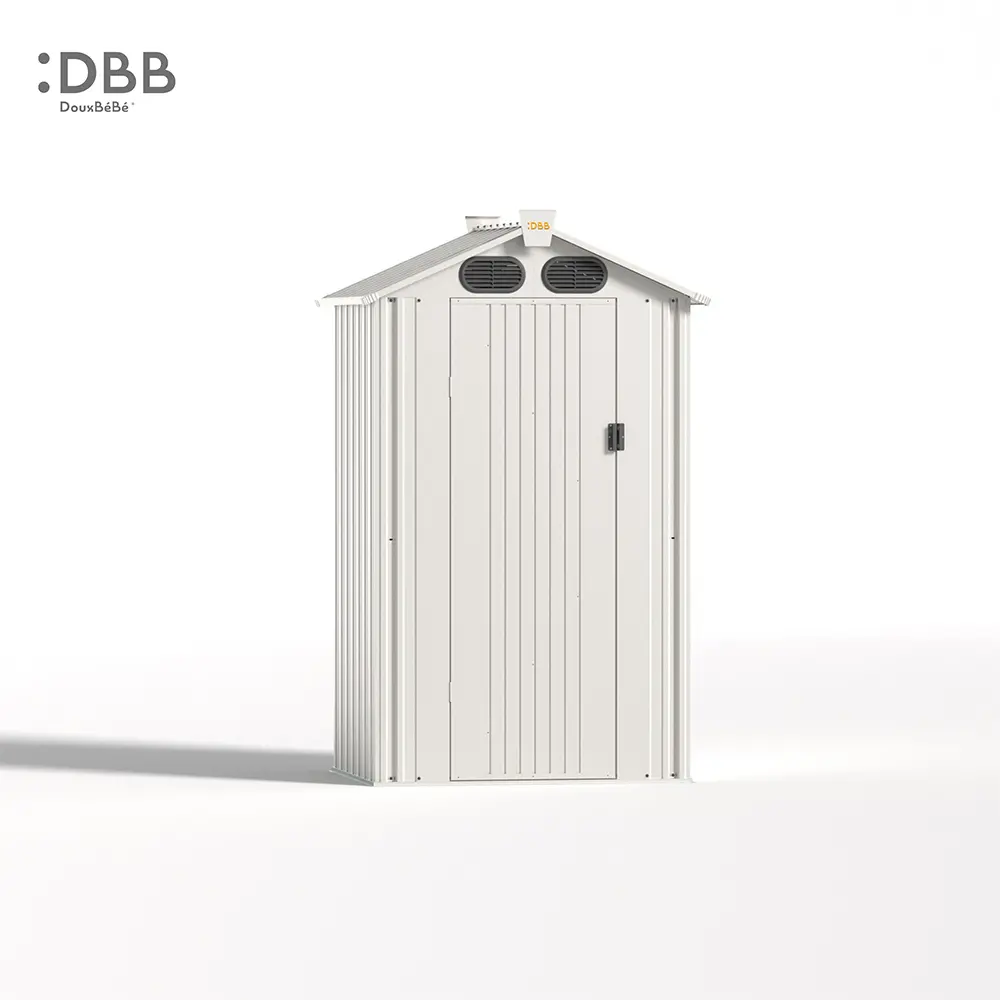
Outdoor structures rarely rely on just one material. A pergola may use an aluminum frame, stainless steel fasteners, polycarbonate roofing, PVC drainage components, and wood-plastic composite (WPC) decking. This combination is intentional: each component faces different mechanical loads, environmental conditions, aesthetic expectations, and maintenance requirements.
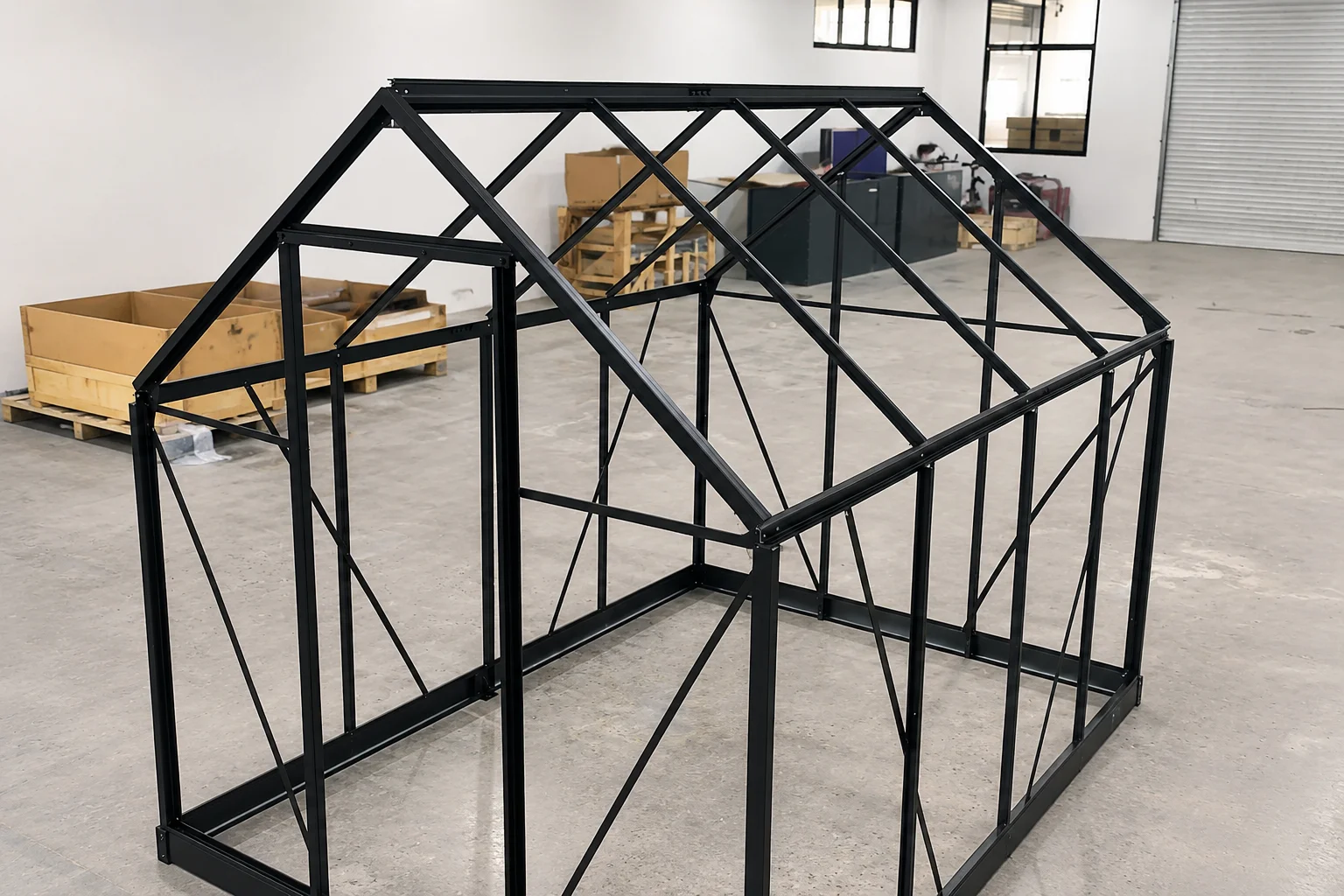
For procurement teams and product developers, choosing between metal and plastic components in outdoor structures is therefore not a simple question of which material lasts longer. The right decision depends on where the component is installed, what it must support, how it will weather, and how much it will cost to own over time.
This guide compares metals, PVC, polycarbonate (PC), WPC, and other engineering plastics, with practical advice for designing and sourcing pergolas, gazebos, awnings, carports, fencing, outdoor furniture, and similar products.
For the main frame, a separate aluminum versus steel comparison helps assess strength, weight, and corrosion exposure.
Why Outdoor Structures Use Multiple Materials
Outdoor assemblies must handle several types of stress at once. Posts and beams resist gravity, wind, and sometimes snow loads. Roof panels provide shelter and transmit or block daylight. Trims and caps protect exposed edges. Fasteners maintain joint integrity. Decking and cladding provide surfaces that users see and touch every day.
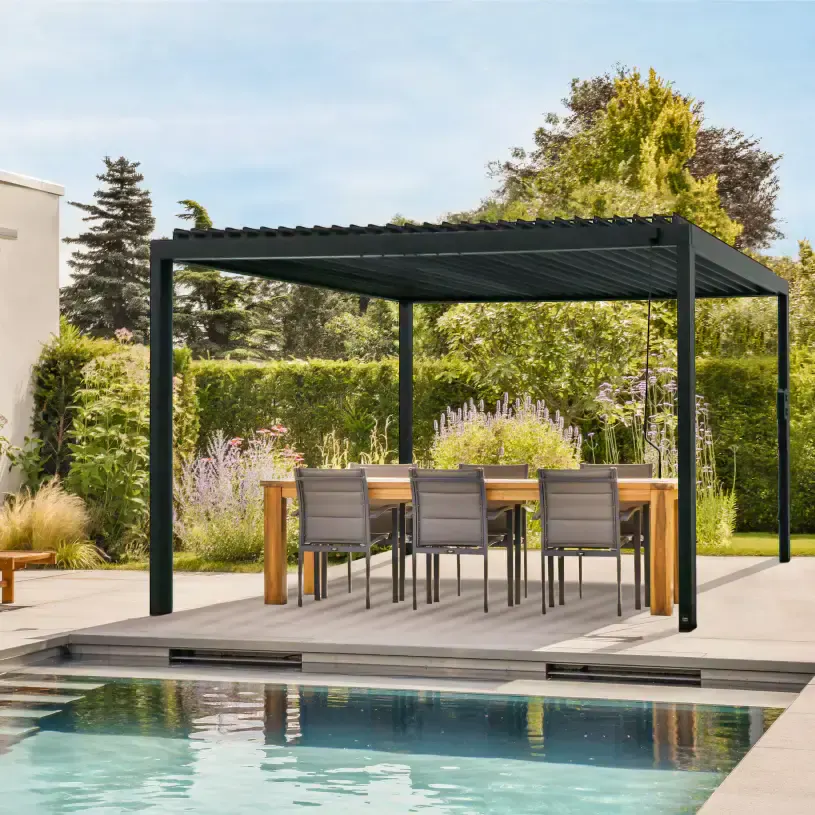
No single material optimizes all these functions. Metals generally offer high stiffness, predictable structural behavior, and durable connections. Plastics can reduce weight, resist moisture, provide transparency, and enable complex molded shapes. Composites such as WPC offer a wood-like appearance without conventional wood finishing cycles.
A successful design assigns materials according to component function rather than appearance alone. For example, replacing a load-bearing steel bracket with standard PVC simply because PVC does not rust would be an unsafe material substitution. Conversely, manufacturing a nonstructural decorative end cap from machined stainless steel may add unnecessary cost and weight.
Metal Components: Strength and Structural Reliability
Galvanized and Powder-Coated Steel
Steel is commonly selected for columns, anchor plates, brackets, connectors, and long-span structural members. Its main advantages are stiffness, strength, established fabrication methods, and attractive cost for load-bearing applications.
However, untreated carbon steel corrodes when exposed to moisture and oxygen. Hot-dip galvanizing adds a protective zinc coating; properly specified paint or powder-coating systems can provide additional protection and visual consistency. Coating performance depends on thickness, surface preparation, edge coverage, exposure conditions, and installation damage.
Steel is relatively heavy, increasing shipping costs and handling demands. Designers should also account for water-trapping details, inaccessible joints, and the need to inspect damaged coatings. In marine or chemically aggressive environments, a basic coating specification may be insufficient.
Best suited to: heavy-duty frames, structural brackets, ground anchors, and components where stiffness and load capacity are priorities.
Aluminum Alloys
Aluminum is popular in pergolas, patio covers, louvered roof systems, and modular outdoor structures. Its low density makes profiles easier to ship, lift, and assemble. Extrusion also permits integrated channels for drainage, wiring, gaskets, and concealed fixings.
Aluminum develops a naturally protective oxide layer, while anodizing or appropriate powder coating can improve appearance and surface durability. Nevertheless, aluminum is not immune to corrosion, particularly where salt, moisture, and incompatible metals collect. Because its elastic modulus is lower than steel’s, an aluminum beam may require a larger section to achieve comparable stiffness.
Best suited to: lightweight structural frames, extruded rails, louvers, doors, and modular assemblies where installation efficiency matters.
Stainless Steel
Stainless steel is often used for bolts, hinges, exposed hardware, and premium connection points. Grade selection matters: 316 stainless steel is frequently preferred over 304 for chloride-rich or coastal conditions, though neither grade is completely corrosion-proof.
Higher material and fabrication costs make stainless steel less attractive for every component. It is typically most valuable where fastener reliability, corrosion resistance, or visible finish quality justifies the premium.
Best suited to: critical fasteners, outdoor hinges, marine-exposed hardware, and frequently operated mechanisms.
PVC Components: Moisture Resistance and Low Maintenance
Polyvinyl chloride (PVC), especially rigid or unplasticized PVC (uPVC), is widely used in outdoor trim, fencing, edging, cable conduits, drainage details, and decorative covers.
Its major appeal is that it does not rust, and properly formulated exterior grades resist moisture, rot, and many everyday chemicals. PVC parts can be extruded in consistent profiles or molded into economical shapes. Most surfaces can be maintained with washing rather than painting.
Yet PVC is not a universal substitute for metal. It has lower stiffness than structural metals and can creep under prolonged loading. Heat may cause expansion, deformation, or loss of dimensional accuracy. UV exposure can affect color and mechanical properties if the formulation lacks appropriate stabilizers and pigments. Impact behavior also changes with temperature and formulation.
For buyers, “PVC” alone is not a complete specification. Ask whether the resin is designed for exterior exposure, whether it contains UV stabilizers, and whether testing covers the product’s intended temperature range. Where fire performance matters, evaluate the finished assembly against applicable local requirements instead of assuming that the base polymer’s behavior establishes compliance.
Best suited to: fencing infill, fascia, trim, drainage, conduit, non-load-bearing profiles, and protective covers.
Polycarbonate (PC): Lightweight, Impact-Resistant Roofing
Polycarbonate is a strong candidate for transparent or translucent roofing on pergolas, carports, patio shelters, and walkway canopies. Compared with conventional glass, PC sheet is lightweight and highly impact resistant. Multiwall polycarbonate can also provide useful thermal insulation with less material than solid sheet.
Not every PC sheet has the same outdoor performance. UV-protected polycarbonate roofing panels are designed to limit weather-related yellowing, optical deterioration, and surface degradation. Buyers should verify the protective layer, its orientation, product warranty, and the manufacturer’s test data.
PC expands and contracts more than typical metal framing. Roof systems need suitable clearances, compatible gaskets, correct edge engagement, and approved fasteners. Excessively rigid fixing may create stress, buckling, or leaks. Panel thickness and support spacing should be engineered for local wind, snow, and impact loads; transparency and impact resistance alone do not establish structural capacity.
Maintenance generally involves gentle cleaning, clearing drainage paths, and inspecting seals. Abrasive cleaners and incompatible solvents may damage certain sheet surfaces.
Best suited to: skylights, patio covers, greenhouse-style panels, daylighting elements, and weather shelters requiring impact-resistant glazing.
WPC: Wood-Like Appearance With Different Engineering Rules
Wood-plastic composite combines wood fibers or flour with a thermoplastic polymer, commonly polyethylene, polypropylene, or PVC. WPC is often used for decking boards, wall cladding, privacy screens, decorative slats, and pergola finishes.
Its key advantage is a timber-inspired appearance without routine sanding, staining, or painting typical of many natural wood installations. Capped composite boards may provide improved stain and color protection compared with some uncapped products, but performance varies significantly by construction and supplier.
WPC is not maintenance-free. Dirt, moisture, and organic debris can contribute to staining or biological growth, and surfaces still require cleaning. WPC can also be relatively heavy, especially in solid profiles. Thermal expansion must be accommodated through supplier-specified end and side gaps. Some boards require closer joist spacing than timber because their bending characteristics differ.
A common design error is treating a WPC deck board as a structural beam. Unless a product has been specifically tested and rated for a structural application, it should be considered a finish or decking component supported by an engineered substructure.
Best suited to: decking, façade cladding, privacy panels, decorative screens, and nonstructural surfaces where appearance and reduced refinishing are important.
Other Plastics Worth Considering
Polypropylene (PP) and high-density polyethylene (HDPE) can be suitable for molded caps, seats, planters, storage components, and corrosion-resistant accessories. Their chemical and moisture resistance can be useful, but outdoor grades need UV stabilization, and structural rigidity may be limited.
Acrylonitrile styrene acrylate (ASA) is valued for outdoor color and weather resistance, making it useful in aesthetic housings and coextruded exterior surfaces. UV-stabilized ABS may work for selected parts, but ordinary ABS is generally less suitable for long-term unprotected sun exposure.
Glass-fiber-reinforced polymers (FRP or GRP) offer an alternative when corrosion resistance and tailored stiffness are important. Their performance depends on fiber architecture, resin chemistry, protective finishes, and joint design. They may suit grating, specialized profiles, and components used in aggressive environments.
These material families are not interchangeable. Product developers should evaluate specific grades, processing methods, and test results rather than relying on a broad polymer name.
Metal vs. Plastic: Side-by-Side Comparison
| Criterion | Steel | Aluminum | PVC/uPVC | Polycarbonate | WPC |
|---|---|---|---|---|---|
| Typical role | Primary structure, brackets | Frames, louvers, rails | Trim, fencing, drainage | Roofing, glazing | Decking, cladding |
| Relative weight | High | Low | Generally low | Low | Moderate to high, profile-dependent |
| Structural stiffness | High | Moderate to high with suitable sections | Low | Limited for primary framing | Grade-dependent; generally nonstructural |
| Moisture exposure | Requires corrosion protection | Generally good with correct detailing | Good | Good with suitable grade | Generally good, but needs drainage |
| UV considerations | Coating color and integrity | Finish durability | Exterior stabilization essential | UV-protected sheet preferred | Color stability varies by formulation |
| Routine care | Inspect coating and corrosion | Wash and inspect finish | Wash and inspect | Clean and inspect seals | Clean and inspect gaps |
| Common limitation | Weight and corrosion | Deflection and galvanic contact | Creep and thermal movement | Scratching and thermal expansion | Thermal movement and support requirements |
These are qualitative comparisons, not substitute engineering specifications. Actual performance depends on grade, geometry, coating, exposure, and installation.
Weather Resistance: Evaluate the Exposure, Not Just the Material
Outdoor durability is location-specific. A sheltered residential pergola in a mild climate faces different risks from a beachfront canopy, a high-altitude carport, or a public walkway exposed to de-icing salts.
Key exposures include UV radiation, temperature cycles, rainfall, standing water, humidity, salt spray, wind-driven debris, and freeze-thaw conditions. A coating that performs adequately in an inland environment may need upgrading near the coast. Similarly, an unstabilized plastic part may discolor or embrittle under intense sunlight even though it is unaffected by rust.
Connections deserve special attention. Stainless fasteners can create galvanic corrosion risks when paired with aluminum or galvanized steel in a wet, conductive environment. Isolation washers, suitable coatings, drainage, and compatible materials can reduce these risks. Designers should avoid crevices that trap water and ensure that damaged or replaceable parts remain accessible.
Specify weather resistance through measurable requirements: UV-aging tests, corrosion exposure, impact testing after aging, allowable color change, coating thickness, and minimum retained mechanical properties. A marketing claim of “weatherproof” is not an adequate substitute.
Weight, Installation, and Logistics
Component weight affects far more than freight cost. It influences packaging, lifting equipment, labor, foundation design, and the safety of installation. Aluminum profiles and multiwall PC roofing may simplify installation compared with heavier alternatives, particularly in modular kits.
However, comparing material density alone is misleading. Steel can achieve a required load capacity using a smaller cross-section, while aluminum may require a larger profile to meet deflection limits. Hollow PVC and WPC sections may differ dramatically from their solid counterparts in weight and stiffness.
Buyers should request assembled-system weight, packaging dimensions, allowable spans, hardware quantities, and installation instructions. The lowest-density material does not automatically produce the lightest compliant structure.
Maintenance and Total Cost of Ownership
Purchase price is only one part of outdoor-structure economics. Total cost of ownership also includes installation, transport, cleaning, recoating, replacement parts, downtime, and disposal.
A painted steel structure may be economically attractive initially but require periodic coating inspections and repairs. Aluminum can reduce handling costs and may need less frequent finish intervention, although mechanical joints and drainage still require attention. PVC trim often needs only washing but may need replacement if it deforms or suffers impact damage. Polycarbonate roofing can remain serviceable for years when correctly specified and installed, yet seals, edges, and damaged panels need inspection. WPC typically avoids conventional timber refinishing but still needs debris removal and cleaning.
For fair supplier comparisons, define an expected service period and assess the likely maintenance activities for each proposed system. Avoid comparing one manufacturer’s premium exterior grade with another’s basic indoor formulation.
Material Selection by Outdoor Structure Component
For posts, beams, and primary roof frames, engineered steel or aluminum is usually the starting point. Selection should reflect structural calculations, span, exposure, appearance, and installation capacity.
For roof infill and daylighting, UV-protected polycarbonate often provides a strong balance of transparency, impact resistance, and weight. Opaque metal panels may be preferable where light transmission is unnecessary or other performance criteria dominate.
For decorative trim, drainage channels, and protective caps, exterior-grade PVC, ASA, PP, or HDPE may offer economical, corrosion-resistant options. The chosen grade should match service temperature and UV exposure.
For decks, screens, and cladding, WPC can reduce refinishing requirements while delivering a wood-like look. Its supporting frame, ventilation, fixing system, and expansion gaps remain critical.
For hinges, bolts, anchors, and critical connectors, select appropriately rated metal hardware with an exposure-compatible corrosion protection system. Do not use general-purpose plastic hardware in safety-critical joints without explicit engineering validation.
Procurement Checklist for B2B Buyers and Product Developers
Before approving a material or supplier, confirm the following:
- Component duty: Is the part structural, protective, decorative, or frequently operated?
- Exposure category: Will it face coastal salt, intense UV, snow, standing water, or chemical cleaning?
- Exact material grade: What alloy, resin formulation, reinforcement, or composite composition is supplied?
- Verified performance: Are relevant test reports available for loads, aging, corrosion, impact, and fire requirements?
- Dimensional movement: Are thermal expansion, creep, deflection, and installation tolerances documented?
- Surface protection: Are coating type, thickness, UV layer, and finish warranty clearly specified?
- Connection compatibility: Are fasteners, gaskets, sealants, and adjacent materials suitable for the assembly?
- Quality control: Can the supplier demonstrate batch traceability, incoming inspection, and consistent production?
- Replacement strategy: Can individual panels, boards, and connectors be serviced without dismantling the entire structure?
- Lifecycle cost: What are the realistic freight, installation, cleaning, repair, and replacement costs?
For international sourcing, request drawings, tolerances, installation manuals, sample approvals, and applicable standards before committing to volume orders. If the application is safety-critical, engage a qualified engineer to verify the complete assembly under local regulations and loading conditions.
Frequently Asked Questions
Is metal better than plastic for outdoor structures?
Neither is universally better. Metal is usually preferable for primary load-bearing members and critical joints. Exterior-grade plastics often work better for lightweight covers, decorative trims, and corrosion-resistant nonstructural parts. Many reliable outdoor products use both.
Which outdoor material needs the least maintenance?
PVC, aluminum, and certain capped WPC products can have relatively modest routine maintenance needs, but none is maintenance-free. Cleaning, drainage checks, and connection inspections remain necessary. Maintenance requirements depend on product grade and local conditions.
Is polycarbonate better than PVC for outdoor roofing?
For transparent or translucent rigid roofing, UV-protected polycarbonate is commonly more appropriate because of its optical clarity and impact performance. PVC can be useful for other roofing profiles or accessories, but the specific sheet formulation and design determine suitability.
Can WPC replace wood or steel in structural frames?
Do not assume so. Conventional WPC deck and cladding boards are generally not direct substitutes for load-bearing timber or steel. Only use WPC structurally when that specific product has verified load ratings and engineering approval.
What matters most when sourcing outdoor components?
Prioritize verified performance in the intended environment, compatibility between materials, documented installation requirements, supplier quality consistency, and total lifecycle cost—not initial price alone.
Conclusion
The best outdoor structures use the right material in the right component. Steel delivers structural strength, aluminum supports lightweight modular frames, PVC provides practical nonstructural profiles, polycarbonate enables impact-resistant daylighting, and WPC offers attractive decking and cladding with reduced refinishing demands. Other engineering plastics can improve specialized details.
For procurement professionals and product developers, the most reliable strategy is to specify component function, exposure, load requirements, maintenance expectations, and measurable quality standards before selecting materials. A well-engineered metal-and-plastic assembly will usually perform better than a design that forces one material to do every job.
Technical References
- American Institute of Steel Construction — Corrosion Protection Summary
- American Galvanizers Association — In Contact With Other Metals
- SABIC — LEXAN THERMOCLEAR Multiwall Polycarbonate Technical Manual
- Timber Decking & Cladding Association — WPC Substructure Guidance
- Washington State University — WPC Maintenance Guidance